Sunday, May 31, 2009

A review that makes me want to buy the book

David Byrne, who has received coverage in this blog before, has become the de facto spokesman for cyclists in New York City and beyond. Normally, I'm the type who resents (to no small degree) being spoken for, but Byrne's eloquence in his review (in today's New York Times Book Review) of Jeff Mapes' PEDALING REVOLUTION: How Cyclists Are Changing American Cities is so compelling that I'm inclined to settle and say, "I'm happy with Byrne being the voice of my generation."

According to the NYT-Book Review editors, Byrne is himself writing a book on bicycling and cities and their intersection called Bicycle Diaries in September. This will be worth reading, as city (and suburban) planning and the impact of cycling on it (and vice versa) is a topic I'm finding more and more interesting.

There is one egregious flaw in Byrne's review. He says therein,
I can ride till my legs are sore and it won’t make riding any cooler, but when attractive women are seen sitting upright going about their city business on bikes day and night, the crowds will surely follow.
I must insist here that it can be only false modesty that allows Byrne to assert that his personal involvment "won't make riding any cooler".

Tuesday, May 26, 2009

Bike to Work [Fill in the Blank]

I attended in mid-May the "Bike to Work Day" held along my morning commute in Columbia, Maryland. It was frankly frustrating, and as probably the only regular cycle commuter in attendance, I felt, frankly, out of place. Who were all these people in colored Spandex, and where did they come from? Unlike last year, when it was a downpour, the weather cooperated, and there was a pretty good crowd of people, I'd say 50 or so. A smattering of the attendees are described below:
  • An older middle-aged woman who steadfastly refused to be convinced that riding with the traffic was safer for her;
  • A group of cyclists who had a 10+ mile commute for which they hadn't figured out the route;
  • A group of bicycle cops, off at a small remove, looking like they didn't belong, and no other cyclists were going over to talk;
  • The usual group of recreational club cyclists waddling around on their racing cleats;
  • Maybe (maybe!) one other person who was outfitted for practical cycling (this was the only other bike with fenders, for God's sake.)
I went off to talk with the cops. They were nice enough guys, if a little clueless about what "bike to work" was all about. I asked them about their training, and they said they had received certification from the International Police Mountain Biking Association, which trains and certifies policemen, EMS, and security people. I asked about the coursework, and they emphasizd the low-speed, crowd-oriented part of the training. (I've since followed up on it, and to me, the PDF coursework summary offered by the IPMBA looks pretty good for a 3 day course.) As usual, I would say, the cops were a little too focused on the hardware. They kept looking at me a little strangely, maybe because I was wearing my "Eclectic Shock" T-shirt (image at right.)

But, getting back to the point. What is the purpose of Bike to Work Day? Is it
  1. To convince people that they can physically manage the ride to and from their place of work? Maybe it does that, but I also suspect that there are enough mishaps (from flat tires, sunburn, and being late to work from simply getting lost) that there is a significant risk that the opposite effect may be achieved.
  2. To allow local politicians to conspicuously ride a bike and thus try and capture the bike riding community as supporters? I suspect that this plays no small role in the planning. For sure, I didn't hear anyone talking about serious new bikeway planning or sharrow painting. (Unlike lucky Boris, see previous post.)
  3. To educate people about safety? There were State of Maryland DOT brochures out about "Bike safety" competent enough I suppose in their content, but they featured a little girl in pigtails on a banana-seated bike as their protagonist, thus perpetuating the image of bicycling as a children's activity.
  4. To ecucate people about what they really need to know about how to commute successfully? In this respect it failed miserably. Success as a cycle commuter requires planning and motivation. Resources promoting either of these were nowhere in evidence.
I suspect the real answer is 2, and so I've become more than a little jaded about bike to work day. I've joined the ranks of Bike Snob NYC who put out a PSA on Bike to Work month. (More and more, I like Bike Snob, even if he does leave me rather breathless.)

Think about it -- even the name is wrong. What does "Bike to Work Day" mean? It should be "Bike to Work Unless It's Bad Weather", or "Bike to Work Year Around". I've come to terms with the fanatical streak that keeps me on my bike and I enjoy the side-benefits, but I must admit I don't have the least practical idea about how to convince others to become regular practical cyclists. That "regular" part is pretty important -- how do you make bike commuting a habit?

Saturday, May 23, 2009

Freak Incident for London Mayor

The mayor of London, Boris Johnson, was nearly caught in a totally freaky accident while testing out likely bike routes for infrastructural upgrading. Johnson and an entourage of about 10 cyclists were properly riding on the left edge of the pavement along a street where parked cars were on the right, and an overtaking truck had a rear hatch swing open, catch a parked car, and fling it (!!!) across the road, nearly taking out (in a major way) several of the cyclists. Luckily, no one was injured, but boy howdy, this could have been messy.

The Wharf account of the incident can be read here; The New York Times also has an account here which includes a video taken from a security camera. One of the riders in the group, also has a couple of Flickr photos here.

This incident is such a freaky one that it's difficult to draw "lessons" from it, but here at least are a few observations (feel free to chime in if you have others):
  • The danger here is by no means confined to cyclists; pedestrians or motorists would have been equally at risk;
  • The truck driver was clearly negligent (in not buttoning-up his truck at the very least) and deserves a healthy fine;
  • The system of sidewalk/curb/bike lane/parking lane/driving lane would have greatly ameliorated (if not eliminated) the risk here;
  • Boris Johnson is one lucky guy, as are his fellow riders;
Freaky Friday, indeed.

Sunday, May 10, 2009

IKEA and bikes

This past weekend, I passed the architect's equivalent of the "busman's holiday", which is, I spent two days in New York City assembling IKEA furniture for my younger daughter who is moving into her own apartment in NYC to take her first job. (Big milestones, you will I hope agree, and particularly poignant on Mothers' Day weekend.)

I am continually impressed with IKEA's value-engineering of their product. Their simple idea is to deliver good design at the least cost. In this case, "good design" means not only visual appeal but also sturdiness without excess weight or material. These are big challenges also for bicycle design, and IKEA stands out as the world-wide champion of achieving this.

Their approach to value-engineering is relentless, and if you assemble (as I did) eight pieces of furniture and observe their VE technique, it's quite remarkable. In eight pieces of furniture, there was only one mistake in execution (a wrong-handed drawer glide was supplied.) The newer pieces used a composite, rather than all-metal, cam-lock mechanism that was lighter, cheaper (no doubt) and held just as tightly as the old all-metal ones. Perhaps most remarkably, in not one of the pieces I assembled (and I did everything from bookcase to desk to dining table to futon) was there either a hardware piece missing or extra.

It's extremely tempting to ask the question, "If IKEA made a bike, what would it be like?" I'm guessing the specs would be something like this:
  • Two-piece reinforced resin 6 spoke wheels;
  • Sealed press-in cartridge bearings everywhere;
  • One wrench required to assemble the whole thing (probably 6mm);
  • Internally geared 3 speed rear hub assembly, in-hub drum brakes front and rear;
  • Single frame size (also reinforced resin or possibly TIG-welded aluminum);
  • Size adjustments with extra-long, cuttable seatpost;
  • Some innovate approach to a fork (maybe a motorcycle style double-post fork with resin crossbars) to eliminate the expensive headset arrangement;
  • Single-chainwheel crank with either belt drive or lifetime lube chain;
  • Standard saddle and pedal attachments to allow for customization / replacement;
  • One-piece (i.e. non-demountable) bars, grips and brake lever assembly.
All flat-packed and user-assembled, of course. The price would I think be in about the $300 range. It's doable with the current technology (and with the VE technology that IKEA has already assembled.)

Then they should sponsor a team in the Tour. (I'm surprised they don't already -- they must have more money than God.)

Sunday, May 3, 2009

San Francisco April-May 2009

So, within one month I've managed to visit both Seattle and San Francisco, both west coast towns that are reputed to be bicycling cities (with the third of the West Coast Bicycling Triplets being Portland, of course.)

I arrived on Wednesday afternoon and arranged to go get drinks and a bite with my friend Scott at Zeitgeist, a fun bar and grill on Valencia street in the "SoMa" district of San Francisco. Arriving at my hotel and unpacking my bike, I discovered I'd left my pump at home (insert self-administered dope slap to forehead here) and so I looked up a nice bike shop called Freewheel just a few blocks south of Zeitgeist. I got down there in plenty of time, got the exact pump I was looking for (a Topeak Road Morph), and had time to do a little sightseeing on South Valencia before heading back north to grab a couple of beers and a burger with Scott.

Thursday night, my company Vectorworks was co-host of what turned out to be just a bang-up party —the City To Green Party— for architects, cyclists and artistic locals at the 3A Gallery on South Park street. In the gallery was an exhibit of track bikes from the second half of the 20th century. The gallery proprietors hung a show of track bikes on the walls and described the provenance of each bike, and detailed descriptions of the bike realization as a work of art. Here's a transcription of one of the the bike descriptions:

---------------------------------------------------------
Automoto, France, 1940s.


Cycles Automoto was a pioneering French maker of motorcycles and bicycles founded at the turn of the 20th century. Well regarded for thoughtful design and meticulous construction, Automoto grew in popularity until merging with the Peugeot group in the early 1960s. Part of that popularity is attributable to the company's wide ranging product offerings, whose bicycle line along grew to include 20 models. When an Automoto advertisement boldly declared, "Le Triomphe De La Qualité Française", few in sound conscience would have doubted the claim.

Built for the professional track racer

Restored condition
Magistroni cranks
Chater Lee Pedals
Major Taylor stem

Collection: American Cyclery of San Francisc
o
---------------------------------------------------------

Quite refreshing. A very well attended party, right to the end, as you can see from the photos. I've often wondered why the intersection-set of architects (particularly young architects) and bicyclists is so large. At least 30 attendees (including yours truly) arrived on bike and were graciously attended to out front of the gallery in a nice bike parking lot attended by the San Francisco Bicycle Coalition , a club of more than 10,000 members. Very, very nice work.

This poem was transcribed in chalk on the walls of the foyer of the 3A Gallery:

Ode to Bicycles

I was walking
down
a sizzling road:
the sun popped like
a field of blazing maize,
the
earth
was hot,
an infinite circle
with an empty
blue sky overhead.

A few bicycles
passed
me by,
the only
insects
in
that dry
moment of summer,
silent,
swift,
translucent;
they
barely stirred
the air.

Workers and girls
were riding to their
factories,
giving
their eyes
to summer,
their heads to the sky,
sitting on the
hard
beetle backs
of the whirling
bicycles
that whirred
as they rode by
bridges, rosebushes, brambles
and midday.

I thought about evening when the boys
wash up,
sing, eat, raise
a cup
of wine
in honor
of love
and life,
and waiting
at the door,
the bicycle,
stilled,
because
only moving
does it have a soul,
and fallen there
it isn’t
a translucent insect
humming
through summer
but
a cold
skeleton
that will return to
life
only
when it’s needed,
when it’s light,
that is,
with
the
resurrection
of each day.

- Pablo Neruda, 1956

I broke 1000 miles for the year so far on the last day of April on the streets of San Francisco. For me, this really cut it. Call me fickle (less than a month ago I was extolling Seattle,) but San Francisco is US Bicycling City Number One in my book.

Tuesday, April 28, 2009

The Bicycling Paradox

Karl Ulrich, a professor from Wharton School of Economics in Philadelphia (and an avid bicycle commuter,) is experiencing some significant notoriety in bicycling blogs as a result of a paper he has written about the "true" environmental savings of bicycle transportation displacing automobile transportation. Most succinctly put, his thesis is this:
Practical bicycling is not a net gain for the environment because the energy savings due to the use of human power for transportation is offset by the increased energy used by living longer due to better health.
I think this paper has good entertainment value, and I'm pretty sure that Ulrich is writing this as a Gedankenexperiment with a little bit of tongue in his cheek. There are a few aspects of his logic and assumptions that I'm not sure I buy, however:

Ulrich correctly calculates the net efficiency differential of auto to bike at approximately 1:32 (I have replicated this calculation elsewhere) but falls into the trap of making a big deal out of the energy cost of agricultural production, thus lowering the differential in the range of 1:6 to 1:9. (This is a pretty big range, by the way.) As I've said before in a letter to the League of American Bicyclists magazine, I think this is a slippery slope. Since food is such an energy-expensive proposition, does Ulrich consider the food consumed by the auto driver? (Or by the driver of the gasoline tanker truck, for that matter?) What about vegetarian locavore cyclists?

Ulrich rightly and justifiably compares the practical cyclist to the athlete who doesn't abandon the use of the motor vehicle. (This includes all those athletes at the health club as well as recreational cyclists). The energy profile is shown in the graph at right. Note that, even with the "stacking of the deck" done by Ulrich in the food-production energy discussion above, the practical cyclist is still superior to the sedentary motorist, if not by much.

There is an excellent discussion of the papers and its putative "holes" here.

By the way, Ulrich is also the creator of the Xootr Swift folding bicycle. If you go to this link for the Swift, and click on the "Guidelines for commuting by bicycle" link, you'll find one of the better one-page summaries of how to be prepared to commute by bicycle, including some recommendations for cold-weather dress that pretty closely parallel my earlier post. Hey, Ulrich is right up the road, in Philly. Not too far from Central Maryland where I live, so the guidelines should be similar. I like the Swift also. Not many folders are specifically sized for the tall (6'5"+) rider, but the Swift has an "XXL" size that is specifically aimed at us tall guys.

Friday, April 24, 2009

AIA-SFO: Integrating Bikes and Business

Next week I'll be attending the American Institute of Architects (AIA) convention in San Francisco. Architects are (at long last) becoming environmental leaders in the professional communities, and "cycling" and "environmental" fit together nicely for me, so I'll be taking a folding bike to push the envelope of "green consciousness" for architects. I don't want to be unfair here—I've noticed that there exists a large intersection among architects, cyclists, and (even) bike builders, it's just that, when it comes to cycling, and particularly practical, everyday cycling, there's a lot more lip service than action. So I hope to turn that around in a small way.

My company, Nemetschek NA, produces a computer-aided design software called Vectorworks. It's used primarily by architects (as I am), but it has great 3D and solids capabilities, and I want to design bikes with it. (This would be just another integration of life, work, and avocation for me.) I've designed buildings and shoes with it, but not yet bikes. If you've used CAD to design bikes, I want to talk to you, so leave me a comment and a way to get in touch!

San Francisco is a city where I've spent time before. And it has hills that are serious challenges to walk up, much less bike up. I don't think I have a bike set up with the gears needed for all of San Francisco.

That's the bad news. The good news is, I'm going to be spending almost all my time in the "SoMa" (South of Market) area, which is quite flat, by SFO standards. Following one of the guiding principles of Practical Cycling, "Research your Route", I've done some homework on SFO. Here's a nifty topographical map of the city overlaid with bike routes. Below is a Google map of what I'm going to be up to. The aqua-colored destination in the middle of the Castro district is where my friend Scott and his wife Polly reside, and that is at the top of a pretty awesome hill, one I don't think I'd try and tackle unless I had about 22" gears. So Scott and I will have to meet elsewhere (maybe at the "Zeitgeist" bar, which is I'm told a favorite of the local bike couriers), or I'll take the bus to his house.


View SFO AIA Convention 2009 in a larger map

So, I've decided to take my folder for the flat areas. I bought (off my brother, who wasn't using it) a Dahon "Speed D7" folder, (mine being about 8 years old, not quite as nice as the one in the link), and a Samsonite "Oyster" standard-airline-case (SAC) that it fits in for transport. I spent a weekend overhauling it, getting it properly equipped for minimal practical cycling (tool kit, pump, lock, patches, lights,) and learning how to pack it. (I made some breakthroughs in this area. There are websites that state that you can't pack a Dahon folder in an Oyster without removing the stem and handlebars, a major pain since I added a cyclocomputer mount. I found that I need only remove the wheels, and everything else fits neatly. (I'll leave the details of that for another post.)

I was in Seattle at the beginning of April and used the trip out there as a first shake-down trip for the travelling cyclist use-case. Excepting a tangled chain on initial unpacking of the bike, everything went surprisingly well. I found the little Dahon, while a bit short in the leg for my tall frame, to still be an acceptable ride for up to, say, 20 miles. I put about 75-80 miles on the Dahon in 5 days, in Seattle, a city not devoid of hills itself. The gear range is rather limited, at both the top and (somewhat surprisingly, given the 20" wheels) the bottom.

So, if you're in San Francisco next week and see the very tall guy on the clown bicycle wearing the Vectorworks shirt, that will be me. Flag me down and tell me you're a reader of A Practical Cyclist, and I'll be glad to invite you to the Vectorworks "City to Green" party on Thursday night! And if by chance you're attending the AIA convention, please drop by the Vectorworks booth, #1651, and let's talk bicycles, design, and computer-aided design.

Wednesday, April 22, 2009

Cycling and Meditation

As I've gotten older, I've mellowed a lot about spirituality. Spirituality of all flavors. I've gotten more into church, especially through singing. (I also pray a lot more these days.) On an irregular basis, I attend meditation sessions with my wife, where we do sitting and walking meditation. Meditation is about being totally present in your life, where you focus on breathing and try and quiet the internal monologue that goes on in your brain. I really enjoy meditating.

When you're cycling in traffic, and really paying attention, it's a form of meditation, too. Think about it -- to be safe, you'd better be 100% in the present. You better know what the traffic around you is doing, you'd better know what the road conditions are likely to be in the next quarter mile, you better know how the traffic signals are sequenced, and you better be watching for pedestrians to boot. (Hey, "pedestrians to boot" -- get it? Never mind.) There is really no room for having your mind wander, not if you want to be safe.

There's really no room to indulge in anger or reverse road rage, either. The only time all last year when I came close to having an accident was when I was agitated when I was signaling for a lane change and a rude driver came right around me, ignoring my signal. I got all bent out of shape, and yelled at the jerk. Within a minute, and while I was still agitated, I came within a hairs-breadth of turning left into oncoming traffic. I must have had a guardian angel give me a dope-slap to pull me out of my agitation and save me. I was really shaken by this incident and by my inattentiveness caused by my not letting go of the anger.

Seeing the danger in "reverse road rage", I resolved to mend my ways. When drivers act stupid, aggressive, or (as is usually the case) heedless, I still shout at them, but then I let it drop, and be over. It's the only way to be really safe. Hanging on to your anger and agitation is just purely dangerous.

Peace, sisters and brothers.

Saturday, April 18, 2009

Bicycle as Fetish

My dictionary defines it thus:
fet•ish |ˈfeti sh |
noun
•an inanimate object worshiped for its supposed magical powers or because it is considered to be inhabited by a spirit.
Now, bear that definition in mind as you read and view this article from the Style (of course!) section of the New York Times, a photo layout of high-fashion models draped over Dutch and high-end American street bicycles. After reading (with no small amount of amusement) this article, I have come to the inescapable conclusion that bicycles are now a fetish in urban America. Since it is defined as bestowing powers, what can we say is the power it might bestow? I submit that the power (in today's America) is coolness.

Bikes have become cool. Partly as a result of Lance, partly as a result of the skinny young bike couriers, partly as a result of the ecological movement, partly as a result of last year's gasoline price bubble, bicycles have arrived.

The fashion models bear witness to this. I mean, really! The set of individuals who would not only bike to work but who would insist on being a fashion plate is very, very small. This is not for societal reasons, it's for practical ones. Let's examine a quote from the Times article:
Can the bicycle, the urban answer to the wild mustang, slow down and put fenders on? Can the urban cyclist, he of the ragtag renegade clothes or shiny spandex, grow up and put on a tie?
I think what's interesting is the way this quote (and the article as a whole) presents this as an either-or. Either spandex or worsted. Either wild or staid. Either adolescent or grown-up. While the either-or is effective as a literary device, I think it's a bit overwrought in this particular case. Let's look at some facts:

"Real" cycle-commuters have to deal with the weather. Even sitting upright on a Dutch bike, in New York City there are probably only about six weeks out of the year (three in spring, three in fall) where you could ride to work a distance of greater than 3 miles and not get either grossly lathered up or pretty darn cold. Fashion cycling is a very limited activity, and people who cycle because they are motivated by fashion-good-looks won't be doing so for very much of the year.

"Real" cycle-commuters have to deal with safety. The Times article states, "Dutch bikes are ridden upright, not hunched over, and you move at a safe, slow gait". Please! Moving at a "slow gait" on the streets of Manhattan is safe? Riding a bike to work, preoccupied with how I'm going to keep my two-thousand dollar Marc Jacobs suit from getting stained or ripped is safe? Not wearing a helmet because "..riding a bike should be normal, and you shouldn’t have to wear a funny Styrofoam hat” is safe?

"Real" cycle-commuters in the City have to deal with New York. The article pays lip service to the ever-present everyday problems of the commuter: the traffic, the fear of theft, the lack of secure bike parking. None of these are made any easier by being dressed fashionably. (Lugging and lifting bikes is a great way to rip tight-fitting pretty-boy suits. I think the look on the face of the model in this picture, dealing with the folding bike, says it all.)

The Times article, in the end, is kind of a mish-mash (or "mashup," the more popular contemporary term). It flits around, and touches on a wide variety of very valid and interesting issues, but doesn't stay with any of them long enough to make sense. Of course, that's not its point. Its point is to sell fashion, which it does admirably with its slide show.

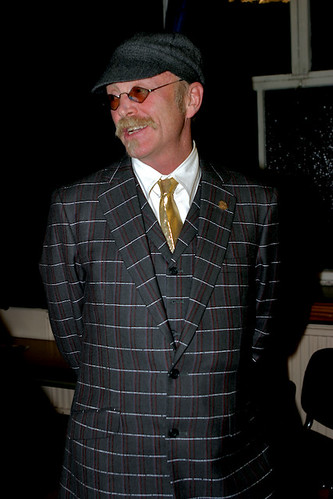
This isn't the first recent intersection of bicycling and fashion that comes to mind. There are the $3000 cycling suits by Rapha, fresh from Savile Row, and the seriously sartorial Dashing Tweeds get-up that bike manufacturer Gary Fisher (right) recently was fitted for in London. The Dashing Tweeds suit is made of Lumatwill, a fabric whose pinstripes are reflective for night riding. Like Gore-tex it's a Teflon laminated fabric, so it's both breathable and waterproof. To me, this is a true bespoke ("custom" for those of you who don't speak the King's English) suit for a cyclist. It's truly forward-looking and (assuming as I must that it's cut for freedom of movement) represents something that could be seriously used by a commuter on those days when he just has to wear a suit.

David Colman of the Times has put up a visually interesting article, but ultimately it's about the conventional fashion trade. It seems ironic to me that there's a true story going on about cycling and cycle-clothing, however, and they're missing it.

PS: Hey, NYTimes, where are the female models? Is it just too hard to reconcile the way that real female cyclists look with the current uber-anorexic female fashion model?

Tuesday, April 14, 2009

Age, Treachery, Gravity

This morning (it was chilly, low 30s) I was 5-1/2 miles into the commute, at the end of a quarter-mile gentle downslope, and a young cyclist on a nice street bike just blew by me. He was in his late 20s, I reckon, and had generally good handling skills (he could set up and take a corner at speed quite well.) I'd been just moseying along, so I picked up the cadence a bit to see if I could keep up with him. He'd put half a block on me, but I noticed two things as I tried to keep up that suggested he hadn't been out much this season: first, he was rocking his head and shoulders quite a bit; and second, he was slowing down on even gentle rises in the road.

My favorite climb of the morning, an 0.6 mile 3% grade, was a half mile ahead, so I just kept pace and bided my time to see what would happen when we hit it. Sure enough, as soon as the upgrade began, he began having trouble finding the right gear. He shifted into too low a gear and began struggling. He must have had a mirror of some kind, because I never saw him look around, but he pulled over as I went around, about an eighth-mile into the climb. I never looked back, but had a great climb, cresting at about 13 mph.

Let me tell you, there's nothing that stokes your self-esteem like smoking a guy half your age on an uphill, early season or no. (I know, I know, I had the "unfair" advantage of having been riding all winter.)

This made me wonder, though, about what kind of advice was out there so I went to Google over the lunch hour and typed in "how to climb hills". The first page of links was all about cycling -- no surprise there. Right up top, I found:
  • Dr. Dick Rafoth's excellent Cycling Performance Tips website that has a host of scientific fact-based information;
  • A very good entry in the late, great Ken Kifer's Bicycle Pages website about the strategy of climbing;
  • A typically-un-informative entry from the eHow website. (I always find eHow unenlightening. It used to be a wiki-type cooperative editing environment, maybe still is, but the entries all seem so darned obvious. Tip number one: use cleats. Tip number two: use the proper gear. Duh.)
  • A quite good article on the REI web site on climbing. Funny, all the times I've ordered stuff from REI, I never looked at that little "expert advice" tab. They have a host of articles on cycling. Many of them are about the kind of stuff to buy (what did you expect, after all?) but this one was pure technique.
So there's a smattering of what's out there. Google it yourself if you want to really pursue this topic. It's funny, I was filling out a questionnaire the other day and one of the questions was, "What do you like about your daily commute?" I answered, "The hills." It seem like a strange answer, but I've really come to an understanding with the gravity part of my ride. I used to really dislike the hills, but now I really like the variety that hills provide, not only variety in the terrain, but also variety from day to day. They serve as a great gauge of how I'm feeling physically and help me to know more about myself. When you hit the hill just right, at just the right cadence, and load your legs just so, so they're "glowing" when you get to the top, but you've still got something left, man, that is a great feeling.

Friday, April 10, 2009

P.U.M.A.

This is too ironic. Here's a verbatim quote from the GM introduction of the "P.U.M.A." auto-balancing two person vehicle made in joint venture with Segway:

"Imagine moving about cities in a vehicle fashioned to your taste, that's fun to drive and ride in, that safely takes you where you want to go, and "connects" you to friends and family, while using clean, renewable energy, producing zero vehicle tailpipe emissions, and without the stress of traffic jams," said Burns. "And imagine doing this for one-fourth to one-third the cost of what you pay to own and operate today's automobile. This is what Project P.U.M.A. (Personal Urban Mobility and Accessibility) is capable of delivering."

Yes. Imagine that. Let's imagine this as a series of bullet points, shall we?
A vehicle:
• tailored to your tastes
• fun to drive and ride
• safely takes you where you want to go
• "connects" you to friends and family
• using clean, renewable energy
• producing zero vehicle tailpipe emissions
• without the stress of traffic jams

I say that my commute (which is to say, my bike) can robustly answer "check!" to all of these with the possible exception of the "connects you to friends and family" item which seems to me to be more like a cell phone than a vehicle. But my bike, maybe kinda sorta, can be said to do even this.

This whole thing beggars the imagination. I've accused GM of incompetence before (before this abomination, even well before the first bailout).

But the point is, really: What does the fact that PUMA can be taken seriously say about us as a society, anyway? Are we so culturally averse to physical activity (and to sweat) that we'll do anything to avoid it, as beneath us? The Roman poet Juvenal described the ideal of the "healthy mind in the healthy body"; the apostle Paul referred to the "body as a temple". It does seem that there is something particularly American about this; you don't see this aversion to activity in Europe. Can this be laid at the feet of Madison Avenue, who basically elevated BO (and therefore sweat) to the level of a mortal sin?

And, does that guy in the photo above have any notion of just how truly dorky he looks? I mean, didn't everyone see Wall-E?


Have we really, truly become South Park? (Thanks to Geeks are Sexy for the reference.) Man, I would feel so much better if I knew this were GM perpetrating an elaborate joke. But I don't think so; they're a week late.

Tuesday, April 7, 2009

Bike Ownership Patterns and Cyclo-computers

It's funny, you know. There seem to be two different types of bicycle owners. The first kind has one bike. Maybe he or she personalizes it, gives it a name. The second kind of owner owns several bikes: maybe a road bike, maybe a fixie, maybe a twenty-niner, maybe a folder, maybe a vintage 70's model. Either kind of owner can be a dedicated rider or not.

But in the case of the second type of owner who happens to be a dedicated rider, there's a market need going unfulfilled, and that is, cyclo-computers with more than two available wheel size settings. They just don't exist as far as I know. The multi-bike example I gave above (and honestly, from perusing the blogosphere, I don't think this is such a rare occurence) could have 4 different wheel sizes on his bikes.

Later this year, as I rebuild my beloved touring bike, I will be in a situation where I have bike with 3 different wheel sizes, and I will be forced to go to wheel reset mode on a regular basis if I want to properly accumulate mileage (and I do.) I'll bet that the desire to have a reasonably accurate cumulative mileage (coupled with the ability to learn one and only one set of controls) would be highly attractive to a growing market segment.

So here's a great opportunity, all you manufacturers of cyclocomputers (and there's probably only about three, maybe four, of you) -- give us some flexibility!