Showing posts with label health. Show all posts

Monday, November 16, 2009

Extreme Cyclist Holiday

I didn't really start out intending to have an Extreme Cyclist Holiday in Houston. I just meant to take my folder along and get some riding in, instead of spending all my time in a car, worrying about gas, parking, etc. Then things just sort of got out of hand.

Let's back up a little. At the last minute, I decided to go to the Rice University homecoming to hopefully see some old friends and hang out some with my older daughter Claire, who helps run a bookstore there. I booked a flight, and found my usual close-to-Rice hotel had some good rates, so I got a room. Then I thought, "Hey, I wonder if I can get from the airport to reasonably close to my hotel using mass transit?" Hopping on the Houston Metro website and entering a couple of addresses, I found that I could catch a bus right at the airport that took me to within a quarter-mile of my hotel with no transfers. Wow. Sixteen miles in Houston for a buck and a quarter. Double wow. (The image at right is from the Houston METRO trip planner, very convenient.)

So, that axed the rental car, which saved me about a hundred bucks, probably a hundred thirty with gas. Ka-ching. But it also meant that my in-town trips would be either by bus, by taxi, or by bike. (Now there's an easy decision.) Houston is flat, and the November weather in Houston is really perfect for riding (high 60's to mid 70's, and not terribly humid). And good weather (no rain) in the forecast.

So, to make a long story short, I spent an entire weekend (three days, Friday, Saturday, and Sunday) in Houston, Car City USA, and not once did I even get into an automobile. It didn't seem strange until early Sunday when I realized that I hadn't been in one. Of course all my old classmates thought it weird, but I caught some whiffs of envy among the incredulity, when they asked, "You're kidding! You BIKED to the party?"

Good things: Saving money, great exercise, the flatness of Houston (my little Dahon folder is great for packing, but really not much for hills), Rice University bike parking facilities (basically, good secure bike racks everywhere), not having to worry about parking a car, Daniel Boone's Cycle Shop, and great weather.

Some people complain about Houston drivers. I was told by the bus driver (friendly guy) coming into town that Houston drivers don't respect cyclists, but I had zero bad experiences over about 60 miles in 3 days. Of course I was in a university part of town, where there are quite a few cyclists, but overall, no complaints from me about Houston motorists.

Not so good things: Houston has the world's narrowest bike lanes (where they have them), and the paving in Houston is the pits. Literally. Basically, Houston is built on the flat gulf-coast plains that have a lot of clay in the soil. This "gumbo" as it is called is just hell on pavement. I found myself weaving a lot more than I wanted to be to avoid really nasty potholes and large cracks.

I even had an accident because of the bad roads! It was late at night and I was riding back to the hotel from my daughter's apartment. I hit a bad pothole (hard to see) and went right over the bars (not hard to do on a short-wheelbase, small-wheeled folding bike.) Luckily, no injuries beyond some bruised kneecaps, as I wasn't going all that fast. Not even any torn clothes.

The funny thing is, I picked myself up and dusted myself off, determined the bike was rideable (it needed the derailleur hanger bent back into proper position) and proceeded home. The next morning, I got up early and looked at bike and saw what I missed the night before: my cyclo-computer was missing. Muttering under my breath at my obliviousness the night before, I hopped on the bike and went back to the accident site (I figured if I waited, there was more chance of it getting smashed by a car) and there it was, flung up in a driveway, fully operational. I clipped it back on and went back to the hotel for breakfast.

But it's been almost 30 years since I had an over-the-bars experience! I'll probably be sore for several more days, but the only cure for that is more riding. I really wouldn't mind not ever going over the bars again, ever. Good thing I was wearing gloves. But the accident seemed to underscore the "extreme" quality of the weekend.

I have to say though, I wouldn't hesitate in the least to do a pure "bike holiday" again (except for the accident part). A little planning can yield a lot of riding, and a lot of fun.

Friday, October 16, 2009

Bike fitting

Bike fitting, buying and finding and adjusting a bike to work well with your body, your flexibility, your strength, and your needs, is an important topic. Today I've put together a post that covers some of the online resources for bike fitting, and also briefly discusses fitting services and systems.

On-line Guides: First I'll give a brief survey of some of the online fitting guides. At top right is a chart detailing the topics covered by these sites:

Rivendell Bikes has a nice online guide for choosing a bike. This is predominantly a guide for choosing a frame size, based predominantly on pubic bone height (AKA "inseam"). It has an interesting rule for how to determine the leaning angle of the torso. This is oriented towards comfort and not racing sizing (which really is not addressed by any of these sites.)

Bikerowave (love the name) has a pretty plainly presented (looks like a forum entry) discussion, but the information there is good.

Jim Langley's excellent site has made the posts of this blog before. He presents fitting as a troubleshooting guide. Good if the bike you already own falls within the range of what you need, not so useful as a buyer's guide. (Langley quotes from Ivan Illich -- hm, good topic in itself for some future post.)

Kirby Palm's long discourse on bike fitting is encyclopedic. Anyone who can write this much on a topic probably knows something about his subject. If not, let's hope he gets lucky. Seriously, this is arranged in a somewhat wordy narrative, but is quite comprehensive and useful.

Peter White Cycles has a page on the topic. It provides some general advice on frame fitting as well as advice on selecting the kinds of merchandise Peter sells. (I really like Peter's site and sincerely appreciate the information he provides. I would buy from him a lot more if he made it easier to do so.)

The Colorado Cyclist site has a thorough (if not particularly broad) guide. It uses a step-by-step approach that I like in this kind of guide.

Wabicycles has a frame-spec focused site that is oriented toward fixies. It information is compactly organized and not unsophisticated. Definitely the place to go if you're thinking about converting that old Raleigh from the '70s into a fixie.

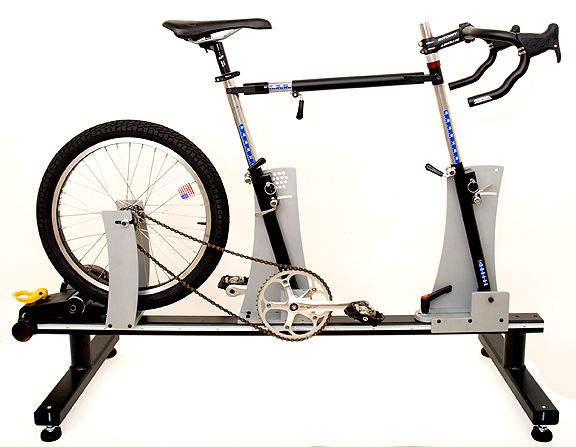
Fitting Systems: Let's suppose, however, that you don't feel confident about measuring a bike (or yourself) and just want to have it done for you. There are a couple of bike-fitting hardware systems sold to bike shops whose personnel are usually certified to use them. Perhaps a shop in your area has one of these systems:

Bike Fit Kit: The "Fit Kit" sold to cycle shops to determine bicycle fit. Since they sell the kits, they don't "give away" their methods online, but visiting their site is interesting in what it says about their approach.

The Fitmaster is the all-in-one fitting machine seen in many bike shops. Shops in at least 25 states in the US have these. A nice, integrated system combined with training on how to use it. This is a good investment for any bike shop, it would seem.

Some randomly-chosen services using (probably) one of the above systems are listed below:

Ride Boutique is certified on several different fitting systems. If you live near Ann Arbor and have a couple of Benjamins to spare, this might be time (oh, yes, and money) well spent.

Papa Wheelie's bicycle shops (again, I love that name) in Boston and Portsmouth, NH also has advanced fitting services. They mention the magic word, "chondromalacia," which I suffer from.

Bicycle fitting services in Tampa, FL. Seem reasonably priced.

eBooks: Lastly, you may simply be a book person, and the comfort of the printed page (that is, if you're willing to print it yourself, as these are ebooks) is the way to go for you. (I can certainly understand this.) There are a couple of titles that come to hand, based on my Internet search:

Arnie Baker's "Bike Fit" ebook. If you're a learning-oriented, self-reliant kind of person, this may be for you. A whole lot less expensive than a fitting session, too.

Andy Pruitt's Medical Guide for Cyclists. Ebook. Combines a section on bicycle fitting with a section on injuries / prevention / care.

Monday, September 21, 2009

It's a "Bike" only because it has two wheels...

Here's the "Yikebike", a Kiwi-designed transportation device that is going to get a lot of press as the successor to the Segway. In some ways, it's a worthy successor. Here's the remarkably well-produced marketing movie, replete with Europop-music, neon-green contrail, and catchy phrases.

The Yikebike is a foldable, baggable, portable, minimalistic electric transportation system. It's not an "E-bike", at least insofar as there is no way to pedal the thing when the battery runs out. It's not high-performance, as most average-to-good urban cyclists could whip it soundly over a short course of a couple of city blocks.

The "YikeBike" has been getting more coverage on gadget blogs than on cycling blogs, and this is for good reason. (It's not, after all, a bicycle as we think of it.) Here are some pertinent specs:
  • Range: 9-10 kms (5.5-6.3 miles);
  • Payload: 100 kg (220 lbs.) including baggage;
  • Charging time: 20 mins for 80% charge;
  • Charging cost: $0.15-0.20;
  • Vehicle weight: 10 kg;
  • Cost: Between $5200 and $5900.
There's a lot to like about the YikeBike concept, especially its product design. The folding design is top-notch, really well thought-out, and clever to boot (I love the "penny-farthing" iconography combined with the "Keep-on-Truckin" posture of the rider). The unit, when folded, appears to be actually compact enough to sling over a shoulder in its special bag. The steering system is compact, innovative, and (at low speeds at least appears to be) effective. The marketing (so far) is quite catchy. But as a serious alternative to bicycles (and let's be fair, it does present itself as such an alternative in its movie), it fails. The range is too short as an alternative to cycling (my daily commute is twice the YikeBike's range each way), and certainly too short as an alternative to car-commuting (which it also tries to undertake).

This raises the problematic question: if the YikeBike isn't a serious alternative to cycling or aut0-commuting, what is it an alternative to? The uncomfortable answer: walking. Walking on a very short commute, or walking to and from the bus-stop. Not even an e-bike purports to replace walking, typically they replace hill-climbing. (And that's fair enough, I suppose.) E-bikers will actually pedal on the flats, extending their range indefinitely, although too bad for them on the climbs when the juice runs out.

I say we need more walking, not less, and therefore I predict the YikeBike will join the Segway in the pantheon of vehicles for sore-footed tourists who want to do extended-range walking tours in urban settings. There are a lot of good design ideas there, though.

Postscript: what do I really, really, really like about the YikeBike movie? Check it out. The uber-cool YikeBiker is wearing Chuck Taylor All-Star Black Monos. This is the ultimate shoe in the world. It can be worn anywhere: your local skateboarding park, a cocktail party, with a tux to an opening at the Kennedy Center. It's green, recyclable, and your yoga teacher will like it, because it folds and gives your feet an opportunity to learn how to Walk Right. I own two pair (one high-top and one low) and am happy to bestow on them the Practical Cyclists' Seal of Approval. (Now if Converse only made them SPD compatible!)

Thursday, September 10, 2009

Yearly Checkup

On Tuesday of this week, it was time for my annual physical exam. I don't know how you feel about "the checkup", but for the last few years, it's something I really look forward to. To put things in perspective, 3-1/2 years ago, here's where I was. I:
  • weighed 250 lbs.
  • had a BMI of almost 29
  • had blood pressure of 140/90 (taking medication), and
  • was pre-diabetic.
Today, after 3-1/2 years of incorporating practical cycling and eating right into my lifestyle, here's where I am. I:
  • weigh 200 lbs.
  • have a BMI of 23
  • have blood pressure of 110/70
  • have absolutely normal blood sugar
  • have total cholesterol of 179, with an HDL of 65, and
  • no meds (well, a buck's worth of dietary supplements a day.)
My annual-checkup conversation with my doctor begins something like:
"Hi, Doc. How's business?"
"It's OK. (looking at my charts:) You know, you're in pretty good shape."
"Well, all you have to do is fit large amounts of exercise into your lifestyle and eat right."
"Yeah, but who wants to do that?" (smiling)
Bicycle commuting hits the "sweet spot" in turning around the American health care crisis. I know that this is a strong statement, but not really too strong. Ask yourself, what would happen if a large percentage of Americans who lived less than 10 miles from their work just "did it"? (Hint: Big Pharma wouldn't like it.) Most Americans don't believe they can afford the time to fit enough exercise into their lives (and this is no doubt true for people in every developed country, except perhaps Denmark and the Netherlands.)

"Health care" is what cycle commuters do every day. Physical health, mental health, and spiritual health. Is it Utopian to talk this way? I don't care.

Saturday, September 5, 2009

The Case against Vitamin I

Outside of my addiction to strong coffee and being a moderate consumer of alcohol, I'm not a big user of drugs of any kind. My family physician would probably tell you (if you asked and if it were legal for her to answer, which it's not) that I'm averse to them. She will give me prescriptions and I ask for homeopathic alternatives, which she, to her great credit, is happy to recommend.

So it is with over-the-counter remedies for me also. I don't like using them unless I really need them. It's my (gut-level and totally unconfirmed) theory that this practice makes the drugs more effective for me when I need them. (Here's a link to learn more about the image at right.)

I first came across the term "Vitamin I" (referring to ibuprofen, aka Advil or Motrin) in one of Selene Yeager's columns in Bicycling magazine. It seemed humorous to me at the time, and it was understandable that such an effective drug might be seen to be effective as a general prophylactic (i.e. preventative) against aches, pains, and inflammation.

My first inkling that this might not be the case was a cautionary page that I came across at the website of a company called JointHealing, from whom I bought a compression knee brace to ease the chondromalacia that I experience in my right knee. (Highly recommended supplier if you're in the market for a joint brace.) They had an article about the use of glucosamine sulfate for rebuilding cartilage that suggested that the overuse of NSAIDs (non-steroidal anti-inflammatory drugs, of which ibuprofen is one) might actually negatively impact growth of new cartilage. The use of "vitamin I" and similar drugs was described as possibly making the problem you are trying to fix worse. Red flag number one.

Red flag number two came in the form of an article this week in one of the New York Times blogs. This was much more alarming. I won't reiterate the entire piece here (bad etiquette, and besides, that's why I gave the link), but summarized, a highly-regarded physician from UNC's Human Performance Laboratory studied runners in an ultra-distance (100 mile) race before and after the event. Here are some of the findings:
  • A significant majority of the participants were using ibuprofen before and during the race;
  • There was no significant difference between users and non-users of NSAIDs in their pain levels;
  • NSAIDs slow the healing of injured muscles, tendons, ligament, and bones;
  • Perhaps most disturbing, NSAIDs may actually increase one's chance of injury by inhibiting the natural response of the body to form stronger bones and tendons as a result of exercise (note the echo here of the caveat given in the JointHealing article);
So, if you're taking ibuprofen as a preventative as (apparently) many do, it would seem that the current prevailing research suggest that you should cut that sh*t out!

Thursday, August 27, 2009

Is Cycle-commuting Blue-Collar?

Turn away from your animal kind
Try to leave your body just to live in your mind
—James Taylor, "Gaia"

This is one of those posts that I could probably take days to carefully write, but I won't. I've been thinking about people's relationships with their bodies. It is such an uneasy thing in the modern world. A massive proportion of Americans (and those in other countries) are obese, overweight, or otherwise obsessed with their bodies.

Datapoint 1. In a recent interview on the PBS NewsHour with Gwen Ifill, Eric Finkelstein, the director of health economics of RTI International, when asked about the cause of the obesity epidemic, said:
Well, we argue it's because of economics. Essentially, the calculus has changed so it's just easier and cheaper to engage in behaviors that promote obesity and more difficult to engage in those behaviors that are associated with fitness.
Datapoint 2. A recent article in the New York Times discusses in some depth the phenomenon of formerly white-collar Americans indulging in a romance with blue-collar trades and questioning the "hollowness of white-collar work." They romanticize not only the physical challenge but also the skills involved in blue-collar work.

Datapoint 3. I've been observing the number of bike racks on the back of/ on top of cars. It strikes me as intensely ironic that many Americans view bicycles as something that it's OK to use for exercise or recreation, but its somehow weird to ride practically, to commute.

I know, I know, people are frightened of cars. I know, I know, people can't sweat at the office, they might end up smelling bad. But I'm not buying it. I don't think the reason(s) that people don't cycle-commute are practical, because fundamentally, if viewed rationally, the reasons to bike are much stronger than the practical reasons not to bike.

I think at the root, that Finkelstein had it right, it's a deep thing that is rooted in economics and the status associated with that. People don't ride bikes to work because it's practical and frugal to use your body in this way, and therefore somehow low-class. It's high-class (go figure) to demonstrate that you control enough resources to be able to fritter them away.

I'm telling you, people's relationship with their bodies is complex.

Thursday, August 13, 2009

What about Free Speech?

Here's a "news of the week"-type story that hits me. Dr. Jason Newsom, an Iraq-veteran MD serving as head of Bay County Health Department in Pensacola, Florida, put up an electronic sign outside his offices with message such as:
  • Hamburger = Spare Tire
  • Sweet Tea = Liquid Sugar
  • French Fries = Thunder Thighs
Everything was going fine until he took on Dunkin Donuts. When he programmed the sign to read:
  • America Dies on Dunkin'
Well, that cut it for a county commissioner who owns a doughnut shop and two lawyers who own a new Dunkin' Donuts on Panama City Beach. They got him fired; his bosses at the state Health Department told him that his leadership wasn't wanted and that he could be fired or resign. He chose to resign May 8 but has reapplied for the job.

This is outrageous. The man's job description not only included but revolved around educating the public about health issues. What could possibly be more on-point for this job than telling people that the crap that they eat is killing them?

Newsom said,
I picked on doughnuts because those things are ubiquitous in this county. Everywhere I went, there were two dozen doughnuts on the back table. At church, there were always doughnuts on the back table at Sunday school. It is social expectation thing.
I am so with this guy. How can people put garbage in their mouths and not be aware of its effect on them? And WHOSE JOB IS IT to educate the public? Obesity, diabetes, hypertension, I'm told these are all epidemic in our society, and the cost is enormous. I hope Newsom wins his job back and if he doesn't, I hope he sues. This is injustice of the most heinous kind.

Monday, August 3, 2009

Use Case for a Practical Cyclist

There are many particular "use cases" for practical cycling, but few come to mind that are any more compelling than Taking The Car To The Shop. In non-practical-cycling terms, this is one of life's little pains, right? You have to have your spouse/SO/family member take you or pick you up (and burn double the fossil fuel in doing so), or else you have to cool your heels at the auto shop for a shuttle (that's assuming they even have a shuttle), OR you have to get a taxi. Inconvenient, frustrating, and/or wasteful all the way around.

On the other hand, if you:
  • have figured out a good route to/from the shop to your home;
  • have a way to carry a bike on or in the car being serviced; and
  • want an excuse to ride your bike,
..then Taking The Car To The Shop is just a fun couple of hours (except for the repair bill, which is yet another reminder (as if I needed one) that cars are expensive and troublesome!)

Finding excuses to ride your bike (as opposed to finding excuses to avoid riding your bike) is what the Practical Cyclist's life is all about.

Thursday, July 16, 2009

Practical Cycling Defined

I define practical cycling most succinctly as "cycling miles that displace motor vehicle miles."

A group of six (only six?) high-school counselors has done a significant bit of practical cycling by touring college campuses (in my stomping ground, in Maryland, Pennsylvania, and Delaware) to check them out for their student counselees. Twelve days, more than a dozen colleges. 400 miles. (Now that I think about it, although that's only 33 miles a day, it still would take some selling to convince most people not doing serious cycling already that they could handle that.) This is significant. Yes, it's billed as "combining a serious tour with their love of bicycling," but this is ordinary people doing a sustained tour at 1/4 to 1/3 the rate of the Tour de France.

The story in the New York Times is here.

I'm impressed, and I hope their numbers grow next year.

Sunday, June 7, 2009

Core routine

One of the things I've done over the past couple of years is try and keep my core muscles in decent form.

It is said about the "core" (i.e. abdominals, lateral abdominals and lower back muscles) that their strength is required for good bicycling form, but that bicycling doesn't help to develop them. (This seems a little contradictory to me, but it's not worth arguing about.)

In the March 2007 issue of Bicycling magazine, there was an (ahem, eye-catching) cover article by Dimity McDowell on abdominal development, along with a good Pilates-derived set of exercises. I've used this set of exercises as my "base" for a couple of years now and have added a few. The good news is this: I belong to a health club system that includes clubs that are 3.8 and 7.5 miles from my house. Depending on the amount of time I can spare, I can bike to the club, do these exercise in less than 30 minutes, and bike home for a cool-down and shower. (This is such an efficient use of time! Cycling to and from the club to get the aerobic segment of a workout is "practical cycling" defined.) Even though I like going to the club to do these, if you don't have time or don't belong to a club, these are easy to do at home on a yoga mat or extra piece of carpet. Two of the exercses require an exercise ball.

So here's my routine (except for the customary push-ups, exercises are all from the Bicycling article):
  1. Boxer Ball Crunch (40 reps CW, 40 reps CCW)
  2. Power Bridge (40 reps)
  3. Hip Extensions on exercise ball (40 reps)
  4. Plank (as long as possible, 1 to 2 minutes)
  5. Transverse Plank (30 sec. each side)
  6. Pushups (20 reps, or as many as possible with good form)
  7. Scissor Kick (2 x 50 reps)
  8. Catapult (25 reps)
  9. Boat Pose (40-45 sec.) (This is a challenging exercise and always gets the attention of the young turks!)
Then I cool down and stretch before getting back on the bike for the ride home:
  1. Pelvic Clocks (20 reps CW, 20 reps CCW) (PDF of exercise here)
  2. Supine Spinal Twist (2 each side, very relaxed, concentrate on breathing out very slowly)
If you find the illustrations of the exercises in the Bicycling link too small, there are some good online descriptions of many of the exact same exercises here.

Thursday, June 4, 2009

Before and After: My Diet

So, here's a little bit about my personal history. I can identify pretty much with "before"/"after" stories, as I'm one of those guys who has a "before" and "after" myself. My story is this: in February of 2006, I weighed about 250 lbs, large but not crazy-overweight for a guy who is 6'6" tall, and I was getting regular exercise, a lot of it on my bike. On my annual checkup that month, my family physician told me I was borderline diabetic. This came as a rather nasty shock, as my dad was diabetic, and his diabetes (and associated heart disease) drastically shortened his life (he died at the age of 56, after his third heart attack.) It's hard to overestimate the dread with which I beheld diabetes, so to say I was motivated to change is putting it mildly.

My doctor told me I had to find (as she put it) "a new baseline" in my dietary habits. She directed me to the Whole Foods Diet developed by the Health Sciences Center of the School of Medicine at Texas Tech University. What I really like about this diet is one of its organizing principles: it's not how much you eat, it's what you eat. This is a controlled-carbohydrate diet that (other than refined carbos) lets you eat all the whole foods you want. I found myself eating a lot of fresh fruit, because of the convenience. No preparation, immediate hunger abatement. The important and fundamental thing is, I was never, ever hungry on this diet.

The results were, I guess you'd say, pretty dramatic. I began losing two to three pounds a week, which is a pretty fast loss on a sustained basis. I basically went from 245 to 195 in about four months. By mid-2006, I reached 195 lbs and stopped losing weight. My BMI went from 28.3 to 22.5. Since that time, my weight has stayed in the 195 to 200 range. These days, I'm on the diet for breakfast and lunch (I almost always pack my lunch to work) and eat pretty much whatever for dinner. I really like being in shape, my marginal diabetes went away (hopefully never to return) and I lost 20mm of mercury off the top and bottom of my blood pressure.

I think motivation is a matter of focus. I was focused on getting and feeling healthy and avoiding the history of my dad. Many people, when they change their habits, focus on what they're missing. I say, don't look back.

Tuesday, April 28, 2009

The Bicycling Paradox

Karl Ulrich, a professor from Wharton School of Economics in Philadelphia (and an avid bicycle commuter,) is experiencing some significant notoriety in bicycling blogs as a result of a paper he has written about the "true" environmental savings of bicycle transportation displacing automobile transportation. Most succinctly put, his thesis is this:
Practical bicycling is not a net gain for the environment because the energy savings due to the use of human power for transportation is offset by the increased energy used by living longer due to better health.
I think this paper has good entertainment value, and I'm pretty sure that Ulrich is writing this as a Gedankenexperiment with a little bit of tongue in his cheek. There are a few aspects of his logic and assumptions that I'm not sure I buy, however:

Ulrich correctly calculates the net efficiency differential of auto to bike at approximately 1:32 (I have replicated this calculation elsewhere) but falls into the trap of making a big deal out of the energy cost of agricultural production, thus lowering the differential in the range of 1:6 to 1:9. (This is a pretty big range, by the way.) As I've said before in a letter to the League of American Bicyclists magazine, I think this is a slippery slope. Since food is such an energy-expensive proposition, does Ulrich consider the food consumed by the auto driver? (Or by the driver of the gasoline tanker truck, for that matter?) What about vegetarian locavore cyclists?

Ulrich rightly and justifiably compares the practical cyclist to the athlete who doesn't abandon the use of the motor vehicle. (This includes all those athletes at the health club as well as recreational cyclists). The energy profile is shown in the graph at right. Note that, even with the "stacking of the deck" done by Ulrich in the food-production energy discussion above, the practical cyclist is still superior to the sedentary motorist, if not by much.

There is an excellent discussion of the papers and its putative "holes" here.

By the way, Ulrich is also the creator of the Xootr Swift folding bicycle. If you go to this link for the Swift, and click on the "Guidelines for commuting by bicycle" link, you'll find one of the better one-page summaries of how to be prepared to commute by bicycle, including some recommendations for cold-weather dress that pretty closely parallel my earlier post. Hey, Ulrich is right up the road, in Philly. Not too far from Central Maryland where I live, so the guidelines should be similar. I like the Swift also. Not many folders are specifically sized for the tall (6'5"+) rider, but the Swift has an "XXL" size that is specifically aimed at us tall guys.

Wednesday, April 22, 2009

Cycling and Meditation

As I've gotten older, I've mellowed a lot about spirituality. Spirituality of all flavors. I've gotten more into church, especially through singing. (I also pray a lot more these days.) On an irregular basis, I attend meditation sessions with my wife, where we do sitting and walking meditation. Meditation is about being totally present in your life, where you focus on breathing and try and quiet the internal monologue that goes on in your brain. I really enjoy meditating.

When you're cycling in traffic, and really paying attention, it's a form of meditation, too. Think about it -- to be safe, you'd better be 100% in the present. You better know what the traffic around you is doing, you'd better know what the road conditions are likely to be in the next quarter mile, you better know how the traffic signals are sequenced, and you better be watching for pedestrians to boot. (Hey, "pedestrians to boot" -- get it? Never mind.) There is really no room for having your mind wander, not if you want to be safe.

There's really no room to indulge in anger or reverse road rage, either. The only time all last year when I came close to having an accident was when I was agitated when I was signaling for a lane change and a rude driver came right around me, ignoring my signal. I got all bent out of shape, and yelled at the jerk. Within a minute, and while I was still agitated, I came within a hairs-breadth of turning left into oncoming traffic. I must have had a guardian angel give me a dope-slap to pull me out of my agitation and save me. I was really shaken by this incident and by my inattentiveness caused by my not letting go of the anger.

Seeing the danger in "reverse road rage", I resolved to mend my ways. When drivers act stupid, aggressive, or (as is usually the case) heedless, I still shout at them, but then I let it drop, and be over. It's the only way to be really safe. Hanging on to your anger and agitation is just purely dangerous.

Peace, sisters and brothers.

Tuesday, April 14, 2009

Age, Treachery, Gravity

This morning (it was chilly, low 30s) I was 5-1/2 miles into the commute, at the end of a quarter-mile gentle downslope, and a young cyclist on a nice street bike just blew by me. He was in his late 20s, I reckon, and had generally good handling skills (he could set up and take a corner at speed quite well.) I'd been just moseying along, so I picked up the cadence a bit to see if I could keep up with him. He'd put half a block on me, but I noticed two things as I tried to keep up that suggested he hadn't been out much this season: first, he was rocking his head and shoulders quite a bit; and second, he was slowing down on even gentle rises in the road.

My favorite climb of the morning, an 0.6 mile 3% grade, was a half mile ahead, so I just kept pace and bided my time to see what would happen when we hit it. Sure enough, as soon as the upgrade began, he began having trouble finding the right gear. He shifted into too low a gear and began struggling. He must have had a mirror of some kind, because I never saw him look around, but he pulled over as I went around, about an eighth-mile into the climb. I never looked back, but had a great climb, cresting at about 13 mph.

Let me tell you, there's nothing that stokes your self-esteem like smoking a guy half your age on an uphill, early season or no. (I know, I know, I had the "unfair" advantage of having been riding all winter.)

This made me wonder, though, about what kind of advice was out there so I went to Google over the lunch hour and typed in "how to climb hills". The first page of links was all about cycling -- no surprise there. Right up top, I found:
  • Dr. Dick Rafoth's excellent Cycling Performance Tips website that has a host of scientific fact-based information;
  • A very good entry in the late, great Ken Kifer's Bicycle Pages website about the strategy of climbing;
  • A typically-un-informative entry from the eHow website. (I always find eHow unenlightening. It used to be a wiki-type cooperative editing environment, maybe still is, but the entries all seem so darned obvious. Tip number one: use cleats. Tip number two: use the proper gear. Duh.)
  • A quite good article on the REI web site on climbing. Funny, all the times I've ordered stuff from REI, I never looked at that little "expert advice" tab. They have a host of articles on cycling. Many of them are about the kind of stuff to buy (what did you expect, after all?) but this one was pure technique.
So there's a smattering of what's out there. Google it yourself if you want to really pursue this topic. It's funny, I was filling out a questionnaire the other day and one of the questions was, "What do you like about your daily commute?" I answered, "The hills." It seem like a strange answer, but I've really come to an understanding with the gravity part of my ride. I used to really dislike the hills, but now I really like the variety that hills provide, not only variety in the terrain, but also variety from day to day. They serve as a great gauge of how I'm feeling physically and help me to know more about myself. When you hit the hill just right, at just the right cadence, and load your legs just so, so they're "glowing" when you get to the top, but you've still got something left, man, that is a great feeling.

Monday, March 2, 2009

A non-bicycling day, a non-bicycling post...

So, today (or more properly last night, although it's still coming down at 10:30 am) the Nor'Easter of 2009 arrived to us here in Maryland. Where I live, it amounts to about 9" of light, powdery snow, easy enough to clear off the driveway, but deep and slippery enough to merit a day to work from home.

I gave my wife (for Christmas a few years ago) a nice bird feeder, a Droll Yankee, and we hung it right outside the breakfast-nook window. It has proved to be a great investment in entertainment. We see cardinals, wrens, titmice, chicadees, finches of all kinds, and occasional other varieties. When it snows, the bird sometimes get a little, well, desperate and crazy. The movie is a brief example of the "bird wars" that sometimes ensue.

Tuesday, February 10, 2009

David Lega: Motivation, Invention, Inspiration

My posts have been a little off this week, as I've been in Europe (Munich / Basel) at a series of management meetings for my job with Nemetschek North America, makers of the CAD product Vectorworks. (This product placement is done for the benefit of the GoogleSearch gurus in our marketing department. You know who you are :)

I attended, late last week, a remarkable motivation-type keynote talk by a world champion Paralympic athlete from Sweden named David Lega. David was born with massive physical disabilities as a result of a virus his mother contracted while pregnant. I won't go into detail on either his disabilities nor his many notable accomplishments, but rather direct you to his website so you can learn more. I will say that if you represent a company in need of a motivational speaker, David will provide an unforgettable talk. David is an athlete, an inventor, a writer, an entrepreneur, a force of nature.

What I want to focus on here is the vehicle that you see David using in the picture. It's a tricycle of unusual design. It is of David's invention (he said it was either the fourth or fifth generation, I don't remember exactly) and it's unique in the world. It's unique because of the unusual nature of David's disabilities. He has virtually no arm or hand function, so a conventional wheelchair (even an electric one with a hand control) is not useful. He's an active and accomplished athlete, so an electric chair with say a mouth control is not interesting nor attractive, because he wants to use the muscles he has (his legs have a limited range of motion).

Take a close look at it and you'll see it's a tricycle of (somewhat) standard layout, but lacking any sort of handlebar. This means that steering and propulsion are both accomplished with foot action. You push a little more with the right foot at just the right moment in the cycle to turn left, and vice versa to turn right. David has developed spectacular and perhaps unique capabilities with his feet, and watching him smoothly navigate this wheelchair around a room is quite remarkable. I wonder if all the people in the room appreciated the skills involved.

Sunday, January 11, 2009

Pearlie-Zoomies

About 2-1/2 months ago, I finally broke down and bought a pair of Pearl-Izumi "lobster" cycling gloves. Numbness and tingling in my hands has been a continual problem for me during the cold months, and these gloves definitively solve it. I used to use three layers; XXXL mountain-biking full finger gloves over fleece over polypro glove liners. It didn't stop the cold-finger syndrome when the weather dropped below about 40 ° F. (4° C.)

I don't do a lot of product endorsements, and I've never received compensation of any kind for any product I've mentioned on this blog (and I won't be starting now.) But I have to say that these gloves really do the trick. I've been cycling in Maryland winter weather this season in weather as cold as 20° F. (-7° C.) and have yet to see the weather that these gloves (along with simple polypro glove liners) can't handle. These gloves are not cheap -- they cost $55 to $65 depending on your source. But comparing that cost to circulation difficulties and attendant possible neurological problems, these guys seem like a bargain.

I call them my "Zoidbergs".

Soon: A systematic approach to dressing for cold-weather cycling..

Thursday, November 27, 2008

Thanksgiving 2008

I'm very thankful to be a cycle-commuter. It greatly increases my health (mental as well as physical), it saves me money, and it does its part to save the planet. It has such a salutary effect on my lifestyle that I'm sure I would bore to tears anyone who asked me why I cycle and was willing to stand around and hear the answer.

One of the questions I therefore ask myself (repeatedly) is, "Since cycling provides so many benefits, why don't more people cycle? What would it take to get more people on the road?" Certainly one (oft repeated here) obstacle is the irrational fear of traffic. (Irrational, that is, for people with traffic cycling skills.) Once a cyclist has a high skill level, it's no problem to cycle in American traffic.

However, it's just not rational to expect a large number of people to somehow magically develop these skills. So in the absence of [insert magical event here], how do we change the environment (and I use the word "environment" in the broadest sense) to effect this desirable change?

I'm not the only person who has been asking this. Fortunately. (If I were, very little would have gotten done.) Dr. John Pucher is a professor in the Bloustein School of Planning and Public Policy at Rutgers University, and he has studied bicycle use in all its variants across the world. Pucher's bio page is here , so I won't repeat it. Suffice it to say that this guy is doing important work in the areas of public policy and public health. He (along with a Rutgers PhD candidate, Ralph Buehler) have written a well researched white paper (PDF) and an excellent presentation (in both video and slideshow form) on the topic "Cycling for Everyone" which studies cycle use worldwide, and which focuses on the ways governments can encourage cycling utilization by policy in the following areas:
  • Better facilities and traffic engineering
  • Integration of biking with public transport
  • Traffic calming of resiential neighborhoods
  • Mixed-use zoning and improved urban design
  • Traffic education
  • Traffic regulations and enforcement
He's given this presentation in various forms in fora in New York City (4/2007), Louisville, KY (4/2007), Vancouver, BC (5/2008) and at the League of American Bicyclists National Bike Summit in Washington, DC (3/2007). So this is no big secret by any means, but it's definitely information that bears repeating, and passing on.

The presentation is in some ways a laundry list, and I think that there are some implementations in Europe that will have difficulty finding acceptance in the US (30-kph speed limit zones for example) but there are many that are already "mainstream" practices in the US, e.g. traffice calming and bike carriers on public transit. The really good news here is, all the policy research has been done. Now it's only a matter of using that research to bludgeon convince our legislators that this stuff is important for our health, our well-being, and our energy policy also. I think the League has done good work in this area, and that's why I'm a member of it.

So, hats off to you, John Pucher. Here's wishing you success in getting your policies put in place. And, as long as we're being thankful, thank you for the good work you've done and continue to do.

Saturday, November 22, 2008

Cycling Deep into Winter

Well, OK, everyone seems to be putting up posts on "Winter Cycling Tips". Here's one over at Paul Dorn's excellent commuting website, and here's another. Now that I've been cycling for a couple of weeks in weather that is often-if-not-mostly below freezing, I guess I can offer some ideas.

Planning: Winter, with its short days and questionable road conditions, is no time to experiment with new routes, at least during the early morning and early evening hours of your regular commute. Stick to the routes you know; if you want to develop some new routes, do it over the weekend, during the day.

Clothing / Accessories / Equipment: I like a layer of full-on fleece (say Polartec 200 gauge) next to my skin, topped with a wind-proof (but uninsulated) shell, and full tights. For mid-20 to 30 deg F. weather, this is really enough clothing. If it gets down into the zero degree range, I might add another layer, but it's possible to sweat this up pretty thoroughly in sub-freezing weather. I find that I warm up about 1.5 miles into my ride, where I hit my first significant uphill. Truth is, where you're exercising, you adapt pretty well thermally.

Protection of Extremities: I have a thin fleece cap that fits under my helmet (I'm probably going to add a balaclava), and I use SmartWool hiking socks. So far I haven't found the need to go to a second layer of socks -- I probably would use a vapor barrier wrap made from bread sacks or newspaper bags before I went to a full-on multilayer sock approach. (For a good discussion of why you want vapor barriers at your feet, go to this link at the venerable Stephenson "Warmlite" site.) The big difficulty I find is keeping my hands sufficiently warm. I wear a light Polartec glove liner under full winter cycling gloves, and my fingers still hurt from the cold at the end of a 9-mile ride. Better to hurt than to have lost feeling, I guess. The next step is to go to "lobster gloves" -- I've ordered some from LL Bean (Pearl Izumi brand) and maybe can find some comfort.

Other Equipment:
One thing you'll need is sunglasses for the morning commute. The sun is low in the sky, and creates a lot of glare. If you don't wear glasses anyway, you'll need eye protection for the evening commute, also. One other thing that I've found, is that it's extremely handy to have a visor on your helmet. This is so you can put your head down to deflect the headlight beams of oncoming cars on dark roads. This keeps you from getting blinded.

Outfitting the bike:
Mudguards (fenders) are essential, of course. Lights that meet the legal minimums also. I like the blinking-LED variety, for the way they conserve batteries. I've also added a large amber auto-reflector to supplement the standard red rear light. If I know the weather is going to be inclement, I don't plan to ride. But I carry extra clothing (a full rain outfit and the aforementioned newspaper bags) to keep me reasonably dry if the weather turns foul. As for tires, you can research and buy studded tires at Peter White's excellent website. For me, right now, if the weather is such that I'd need studded tires so I can ride on ice, hmm. I think I'll not ride that day. That doesn't mean you can't, though.

Motivation: Many of the other blog articles on winter cycling talk about motivation and getting going. It is true that the first mile is the hardest. I think the strategy that has been most successful for me is to just not quit, not get out of the habit. I do think that deep winter would be a challenging time to start a cycle-commuting habit, to say the least. I feel like any week where I can ride 3 days or more is a good week, and I've had mostly good weeks since the end of summer.

If you're planning on regular winter cycling, I hope these little tips have been useful. Be safe!

Monday, October 6, 2008

Brief Interlude

Well, I seem to be having trouble finding time to get to my blog again. (There's probably a word for it - "blogpostaphobia" or something.) Anyway, to while away the time until I can get it together to finish the story of Stockholm, here's a link to the New York Times Biking Travel Guide section. (Did you know the Gray Lady had a section on bicycle tourism? I didn't).

Enjoy! I'll be back soon. Really.