Showing posts with label NY Times. Show all posts

Monday, May 3, 2010

Tufte would be Proud

Ed Tufte is one of the original thinkers of the Information Age. See his website here. I will presume that most readers have at least a passing acquaintance with his books, perhaps fewer with his sculpture. I was struck by a surpassingly nice graphic in last weekend's New York Times that was pure Tufte. A reduced image is at right; click here to go to the original article. Rarely have I seen a more concise graphing of two important (and related) quantities: The price of gasoline vs. the number of miles driven per year (on average) by Americans. Nice to see them researched and correlated. (I also like the way the curve is smoothed out -- it has a nice organic look to it.)

It's pretty shocking to see that between 1968 and 2004, the miles driven by Americans doubled. It's also nice to see things moving back to the left. Do Americans realize that, no matter how nicely appointed their autos, the quality of life while driving is a miserable fraction of that spent out in "the real world"?

All other things being equal, economic theory predicts that instead of such a loopy curve, we'd see a straight slope up from left to right. Of course, this isn't the whole story. To see the entire economic picture, we'd also have to see a supply curve of gasoline produced in the US market for the same period of time. Perhaps also an efficiency curve of average MPG for autos in the US market. Perhaps looking at such a 3- or 4-dimensional graphic would give me a headache!

Monday, December 14, 2009

Jan Gehl, Planner Extraordinaire

A name that I became familiar with only after reading David Byrne's Bicycle Diaries over the Thanksgiving holiday (a complete review is on its way) was that of Jan Gehl, a Danish urban planner who is largely responsible (as far as I can fathom) for making Copenhagen the world bicycling paragon that it is. I have spoken before about Copenhagen and its self-propagated images and perceptions, and frankly, I've been less than complimentary, because I think that the most vocal Danish bicycle proponents confuse cause and effect and fail to give credit where it's due (Mikael Colville-Andersen, in his talk in Washington DC, did not mention Gehl).

But if he is not personally so, Gehl appears to be close to the source itself. He's an architect and planner, and principal in Gehl Architects (who have one of the coolest Flash web front-ends I've ever seen.)

New York has a significant connection to Gehl as well. The New York City Department of Transportation hired Gehl as a consultant to survey its streets in 2007 and, by no coincidence bicycling is up in that city as well. Perhaps related to this connection, the New York Times has seen fit to recognize Gehl in its ninth annual Year in Ideas issue of the Sunday magazine.

Byrne talks about Gehl in several places in his book. He introduces him talking about Melbourne and the success they've had in making their city much more liveable. Byrne describes Gehl as
a visionary yet practical urban planner who has successfully tranformed Copenhagen into a pedestrian- and bike-friendly city.. We here in New York think that's .. all well and good for the Danes, but New Yorkers are .. independent minded, so that can't happen here. But Gehl reveals that his proposals initially met with exactly that kind of opposition over there: the locals said, "We Danes will never agree to this—Danish people won't ride bikes." [emphasis mine]
There are many reasons to be hopeful and engaged after reading Byrne's book, but I must say that I found the above paragraphs to be the most inspirational I'd read in quite a while.

Saturday, September 5, 2009

The Case against Vitamin I

Outside of my addiction to strong coffee and being a moderate consumer of alcohol, I'm not a big user of drugs of any kind. My family physician would probably tell you (if you asked and if it were legal for her to answer, which it's not) that I'm averse to them. She will give me prescriptions and I ask for homeopathic alternatives, which she, to her great credit, is happy to recommend.

So it is with over-the-counter remedies for me also. I don't like using them unless I really need them. It's my (gut-level and totally unconfirmed) theory that this practice makes the drugs more effective for me when I need them. (Here's a link to learn more about the image at right.)

I first came across the term "Vitamin I" (referring to ibuprofen, aka Advil or Motrin) in one of Selene Yeager's columns in Bicycling magazine. It seemed humorous to me at the time, and it was understandable that such an effective drug might be seen to be effective as a general prophylactic (i.e. preventative) against aches, pains, and inflammation.

My first inkling that this might not be the case was a cautionary page that I came across at the website of a company called JointHealing, from whom I bought a compression knee brace to ease the chondromalacia that I experience in my right knee. (Highly recommended supplier if you're in the market for a joint brace.) They had an article about the use of glucosamine sulfate for rebuilding cartilage that suggested that the overuse of NSAIDs (non-steroidal anti-inflammatory drugs, of which ibuprofen is one) might actually negatively impact growth of new cartilage. The use of "vitamin I" and similar drugs was described as possibly making the problem you are trying to fix worse. Red flag number one.

Red flag number two came in the form of an article this week in one of the New York Times blogs. This was much more alarming. I won't reiterate the entire piece here (bad etiquette, and besides, that's why I gave the link), but summarized, a highly-regarded physician from UNC's Human Performance Laboratory studied runners in an ultra-distance (100 mile) race before and after the event. Here are some of the findings:
  • A significant majority of the participants were using ibuprofen before and during the race;
  • There was no significant difference between users and non-users of NSAIDs in their pain levels;
  • NSAIDs slow the healing of injured muscles, tendons, ligament, and bones;
  • Perhaps most disturbing, NSAIDs may actually increase one's chance of injury by inhibiting the natural response of the body to form stronger bones and tendons as a result of exercise (note the echo here of the caveat given in the JointHealing article);
So, if you're taking ibuprofen as a preventative as (apparently) many do, it would seem that the current prevailing research suggest that you should cut that sh*t out!

Thursday, August 27, 2009

Is Cycle-commuting Blue-Collar?

Turn away from your animal kind
Try to leave your body just to live in your mind
—James Taylor, "Gaia"

This is one of those posts that I could probably take days to carefully write, but I won't. I've been thinking about people's relationships with their bodies. It is such an uneasy thing in the modern world. A massive proportion of Americans (and those in other countries) are obese, overweight, or otherwise obsessed with their bodies.

Datapoint 1. In a recent interview on the PBS NewsHour with Gwen Ifill, Eric Finkelstein, the director of health economics of RTI International, when asked about the cause of the obesity epidemic, said:
Well, we argue it's because of economics. Essentially, the calculus has changed so it's just easier and cheaper to engage in behaviors that promote obesity and more difficult to engage in those behaviors that are associated with fitness.
Datapoint 2. A recent article in the New York Times discusses in some depth the phenomenon of formerly white-collar Americans indulging in a romance with blue-collar trades and questioning the "hollowness of white-collar work." They romanticize not only the physical challenge but also the skills involved in blue-collar work.

Datapoint 3. I've been observing the number of bike racks on the back of/ on top of cars. It strikes me as intensely ironic that many Americans view bicycles as something that it's OK to use for exercise or recreation, but its somehow weird to ride practically, to commute.

I know, I know, people are frightened of cars. I know, I know, people can't sweat at the office, they might end up smelling bad. But I'm not buying it. I don't think the reason(s) that people don't cycle-commute are practical, because fundamentally, if viewed rationally, the reasons to bike are much stronger than the practical reasons not to bike.

I think at the root, that Finkelstein had it right, it's a deep thing that is rooted in economics and the status associated with that. People don't ride bikes to work because it's practical and frugal to use your body in this way, and therefore somehow low-class. It's high-class (go figure) to demonstrate that you control enough resources to be able to fritter them away.

I'm telling you, people's relationship with their bodies is complex.

Sunday, August 23, 2009

Apocalyptic, but (hopefully) Funny

No, I'm not talking about the latest Tarantino movie, but about T-shirt designs.

For the longest time, I've been unable to get the irony of the old Sinclair gasoline station signs out of my head. The double-entendre of the "dinosaur" is just too delicious, particularly when applied to (take your choice): petroleum / global warming / large automobiles / SUVs / heedless drivers.

Combining my love of ironic humor with my love of word play, I've mashed-up the old Sinclair sign a bit, finding a new anagrammatic interpretation of the letters, giving ol' Apato a little bit of personality and throwing in a fiery asteroid for good measure (this last element, I must admit, was inspired by Olivia Judson's blog on the New York Times website.)

There are two hi-rez PDF versions, one with a background field, one without (the low-ink version, for those of you printing your own T-shirts on the inkjet printer.) Enjoy, and if you make up some shirts, send me some photos of yourselves!

Thursday, July 16, 2009

Practical Cycling Defined

I define practical cycling most succinctly as "cycling miles that displace motor vehicle miles."

A group of six (only six?) high-school counselors has done a significant bit of practical cycling by touring college campuses (in my stomping ground, in Maryland, Pennsylvania, and Delaware) to check them out for their student counselees. Twelve days, more than a dozen colleges. 400 miles. (Now that I think about it, although that's only 33 miles a day, it still would take some selling to convince most people not doing serious cycling already that they could handle that.) This is significant. Yes, it's billed as "combining a serious tour with their love of bicycling," but this is ordinary people doing a sustained tour at 1/4 to 1/3 the rate of the Tour de France.

The story in the New York Times is here.

I'm impressed, and I hope their numbers grow next year.

Wednesday, June 24, 2009

Times Square

I asked my younger daughter (who lives in New York City) what she thought about the new Times Square makeover (where Broadway has been blocked from automobile traffic in a couple of places) and she seemed dismissive. (She might have called it a "gimmick".) I think that she, as an adoptive New Yorker, wants to keep away from touristy areas, and Times Square certainly qualifies.

It's weird to think about cheap folding lawn chairs in the left-over spaces where Broadway used to cross 7th Avenue (which remains open, by the way.) Supposedly, the city takes up the chairs every night and redistributes them every morning. Is this any way to run a national urban landmark?

But there's something important about the New Times Square makeover by the Planning Department of New York City. If nothing else, it's the first U.S. project (ad hoc though it be) in my memory whose momentum is decidedly anti-car. Nicholai Ouroussoff reviews the "design" in this article. Nick O (as I will dare to call him) is right on the money about the unplanned nature of the action (as he says, "this is not the Piazza San Marco in Venice or even Trafalgar Square", but I think it is so important to expose people (even if they are unwitting tourists!) to the idea that the U.S. can have a "public realm" that isn't driven (sorry!) by traffic engineering.

Over at the very interesting blog, World Streets (newly on my blogroll), there is a very interesting article (which promises to be a series) by Paul Barter, a professor in public policy at the National University of Singapore, about "The Battle for Street Space" that is really worth a read (as is much of the other stuff over there.) I see many people from all over the world on that blog talking about 30 kph (yes, kph) speed limits everywhere except on highways. My first reaction is to lecture these people about how this will never fly in the U.S.; the auto is forever king here. But maybe not -- Times Square is a very interesting precedent. It will be fascinating to see where it goes.

Tuesday, June 9, 2009

Buying a used bike: "Beaters"

I was going to make a post on buying a used bike on Craigslist; what to look for and what to avoid and all that. But the New York Times, bless 'em, has done a better job at this than I could on an article about Beater Bikes. Check it out.

Sunday, May 31, 2009

A review that makes me want to buy the book

David Byrne, who has received coverage in this blog before, has become the de facto spokesman for cyclists in New York City and beyond. Normally, I'm the type who resents (to no small degree) being spoken for, but Byrne's eloquence in his review (in today's New York Times Book Review) of Jeff Mapes' PEDALING REVOLUTION: How Cyclists Are Changing American Cities is so compelling that I'm inclined to settle and say, "I'm happy with Byrne being the voice of my generation."

According to the NYT-Book Review editors, Byrne is himself writing a book on bicycling and cities and their intersection called Bicycle Diaries in September. This will be worth reading, as city (and suburban) planning and the impact of cycling on it (and vice versa) is a topic I'm finding more and more interesting.

There is one egregious flaw in Byrne's review. He says therein,
I can ride till my legs are sore and it won’t make riding any cooler, but when attractive women are seen sitting upright going about their city business on bikes day and night, the crowds will surely follow.
I must insist here that it can be only false modesty that allows Byrne to assert that his personal involvment "won't make riding any cooler".

Saturday, May 23, 2009

Freak Incident for London Mayor

The mayor of London, Boris Johnson, was nearly caught in a totally freaky accident while testing out likely bike routes for infrastructural upgrading. Johnson and an entourage of about 10 cyclists were properly riding on the left edge of the pavement along a street where parked cars were on the right, and an overtaking truck had a rear hatch swing open, catch a parked car, and fling it (!!!) across the road, nearly taking out (in a major way) several of the cyclists. Luckily, no one was injured, but boy howdy, this could have been messy.

The Wharf account of the incident can be read here; The New York Times also has an account here which includes a video taken from a security camera. One of the riders in the group, also has a couple of Flickr photos here.

This incident is such a freaky one that it's difficult to draw "lessons" from it, but here at least are a few observations (feel free to chime in if you have others):
  • The danger here is by no means confined to cyclists; pedestrians or motorists would have been equally at risk;
  • The truck driver was clearly negligent (in not buttoning-up his truck at the very least) and deserves a healthy fine;
  • The system of sidewalk/curb/bike lane/parking lane/driving lane would have greatly ameliorated (if not eliminated) the risk here;
  • Boris Johnson is one lucky guy, as are his fellow riders;
Freaky Friday, indeed.

Saturday, April 18, 2009

Bicycle as Fetish

My dictionary defines it thus:
fet•ish |ˈfeti sh |
noun
•an inanimate object worshiped for its supposed magical powers or because it is considered to be inhabited by a spirit.
Now, bear that definition in mind as you read and view this article from the Style (of course!) section of the New York Times, a photo layout of high-fashion models draped over Dutch and high-end American street bicycles. After reading (with no small amount of amusement) this article, I have come to the inescapable conclusion that bicycles are now a fetish in urban America. Since it is defined as bestowing powers, what can we say is the power it might bestow? I submit that the power (in today's America) is coolness.

Bikes have become cool. Partly as a result of Lance, partly as a result of the skinny young bike couriers, partly as a result of the ecological movement, partly as a result of last year's gasoline price bubble, bicycles have arrived.

The fashion models bear witness to this. I mean, really! The set of individuals who would not only bike to work but who would insist on being a fashion plate is very, very small. This is not for societal reasons, it's for practical ones. Let's examine a quote from the Times article:
Can the bicycle, the urban answer to the wild mustang, slow down and put fenders on? Can the urban cyclist, he of the ragtag renegade clothes or shiny spandex, grow up and put on a tie?
I think what's interesting is the way this quote (and the article as a whole) presents this as an either-or. Either spandex or worsted. Either wild or staid. Either adolescent or grown-up. While the either-or is effective as a literary device, I think it's a bit overwrought in this particular case. Let's look at some facts:

"Real" cycle-commuters have to deal with the weather. Even sitting upright on a Dutch bike, in New York City there are probably only about six weeks out of the year (three in spring, three in fall) where you could ride to work a distance of greater than 3 miles and not get either grossly lathered up or pretty darn cold. Fashion cycling is a very limited activity, and people who cycle because they are motivated by fashion-good-looks won't be doing so for very much of the year.

"Real" cycle-commuters have to deal with safety. The Times article states, "Dutch bikes are ridden upright, not hunched over, and you move at a safe, slow gait". Please! Moving at a "slow gait" on the streets of Manhattan is safe? Riding a bike to work, preoccupied with how I'm going to keep my two-thousand dollar Marc Jacobs suit from getting stained or ripped is safe? Not wearing a helmet because "..riding a bike should be normal, and you shouldn’t have to wear a funny Styrofoam hat” is safe?

"Real" cycle-commuters in the City have to deal with New York. The article pays lip service to the ever-present everyday problems of the commuter: the traffic, the fear of theft, the lack of secure bike parking. None of these are made any easier by being dressed fashionably. (Lugging and lifting bikes is a great way to rip tight-fitting pretty-boy suits. I think the look on the face of the model in this picture, dealing with the folding bike, says it all.)

The Times article, in the end, is kind of a mish-mash (or "mashup," the more popular contemporary term). It flits around, and touches on a wide variety of very valid and interesting issues, but doesn't stay with any of them long enough to make sense. Of course, that's not its point. Its point is to sell fashion, which it does admirably with its slide show.

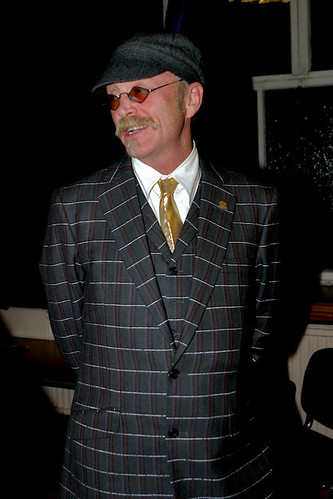
This isn't the first recent intersection of bicycling and fashion that comes to mind. There are the $3000 cycling suits by Rapha, fresh from Savile Row, and the seriously sartorial Dashing Tweeds get-up that bike manufacturer Gary Fisher (right) recently was fitted for in London. The Dashing Tweeds suit is made of Lumatwill, a fabric whose pinstripes are reflective for night riding. Like Gore-tex it's a Teflon laminated fabric, so it's both breathable and waterproof. To me, this is a true bespoke ("custom" for those of you who don't speak the King's English) suit for a cyclist. It's truly forward-looking and (assuming as I must that it's cut for freedom of movement) represents something that could be seriously used by a commuter on those days when he just has to wear a suit.

David Colman of the Times has put up a visually interesting article, but ultimately it's about the conventional fashion trade. It seems ironic to me that there's a true story going on about cycling and cycle-clothing, however, and they're missing it.

PS: Hey, NYTimes, where are the female models? Is it just too hard to reconcile the way that real female cyclists look with the current uber-anorexic female fashion model?

Wednesday, March 11, 2009

Lawfulness & Licensing (Survey)

Once again, the NY Times has a well-written screed about urban cycling. It's here. I have to say that the sentiments of the author, Robert Sullivan, pretty much mirror mine. Riding in an urban environment carries inescapable risks, and it's simply imperative to avoid the risks we can by obeying the rules of the road. As one of the article commenters (from Davis, CA) responds, "same roads, same rights, same rules".

Sullivan, in the concluding paragraphs of his article, makes four suggestions for "better Bike PR":
  • Stop at intersections;
  • Don't ride on sidewalks;
  • Don't ride against traffic (especially on one-way streets); and
  • Signal your turns;
This is all pretty basic stuff, and I agree that universally doing these things will improve the lives of all urban cyclists (practical and otherwise!) but lately, I've been thinking further afield, deeper about this problem, venturing into what I'm pretty sure will be unpopular territory.

Simply put, the question is this:
If bicycles are vehicles, prone to the rules of the road like cars, and fundamentally unlike pedestrians, should bicycle riders who use public rights-of-way be licensed to operate their vehicles?
With no small amount of trepidation, I'm coming round more and more to the conclusion that we should be licensed. I think this solves two fundamental problems that otherwise show no clear way of being solved. These problems are:
  • Lack of Skills Training: Many, many cyclists on the road are woefully unprepared, both physically and mentally, for dealing with traffic issues. They don't know how to recognize dangerous situations and how to avoid them. Any licensing program would have to have a concomitant skills development and testing program to justify the awarding of licenses.
  • Lack of Moral Hazard: If I'm a driver, and I behave irresponsibly, then my license can be revoked, and I have to cease driving (at least if I want to obey the law). This threat of "points" has a strong effect of keeping my more animal impulses in check.
I look at "outlaw" cyclists, the heedless or reckless ones, and see people who are behaving as though under the influence of a drug. (See this post over at the Momentum website for yet another essay / perspective on this by Deb Greco.) Certainly cycling as an experience can convey a sense of euphoria, and it is the dangerous aspects of this euphoria in a public sphere that vehicular laws are intended to regulate.

The question is, should bicyclists play offense or defense? There are those, uh, "colorful cyclist personalities" who insist on the right to play offense. They assert that in Europe cyclists are treated with far greater deference by motorists, and that's the way it should be here, dammit. I'm a pragmatist, and I believe in defense. Cars are big, hot, massive, dangerous. To assert that it "should be otherwise" is all very well, but it is what it is. Much as I like Europe, much as I've enjoyed cycling over there, the US is different. I say that for me, for here, defense is the game.

So, time for an informal, non-scientific survey. The Blogger system doesn't (at least as far as I have discovered) allow for a formalized survey system, so let's do an informal one. If you have read this far, please do me the favor of commenting on this blog post with a letter signifying one of the following survey preferences. Honor code, here; don't be casting multiple votes (I'm pretty sure I can delete multiple votes after the fact, anyway.) As I've implied above, this is primarily aimed as the US, so if you're voting from overseas, it would be helpful for you to say where you're located. Feel free to comment further, but start out your comment with one of the letters A through D:

Question: Should bicycle riders who use public rights-of-way be licensed to operate their vehicles?
  • A. Yes; time to get serious; Particularly as the number of cyclists grow, it will make the roads safer for all of us.
  • B. Partly; Require licensing for bicyclists using roads that have speed limits >= 30 mph. This will allow "family use" in suburban 25 mph zones.
  • C. No; If we provide bike lanes, the safety problem will go away, except for those idiots who want to take crazy risks with their own necks.
  • D. Hell, No; I demand the right to do as I please on a bike; I'm not a car and I shouldn't have to behave like one. We need the government out of our lives.

Sunday, February 22, 2009

Good Cop / Bad Cop [Redux]

This New York Times article gives a recent update on the NYC cop who brutally shoved a cyclist at a Critical Mass night ride on July 25, 2008. He's Gone! This is good news, and actually done in a pretty timely fashion (you may not agree with this, but the wheels of justice do turn slowly.)

Pogan was indicted on December 16, 2008 for this incident. The NYPD said he was fired about February 9, 2009. (There was no press release on this. It's a little understandable that the NYPD doesn't care to shine a light on its most questionable officers, but on the other hand, it's also a clear PR opportunity missed.) The press accounts say that charges have been dismissed, and that a "spokesman" for Pogan (do 23-yr old cops get spokesmen now?) said that Pogan resigned, and was not fired. In any case, the dropping of charges was no doubt a quid pro quo for getting rid of this bad apple, and the NYPD just wanted it done.

I first reported on this last August. You can see a video of the incident here (my original YouTube link has gone stale).

I feel pretty strongly about this (in case you hadn't guessed) as I'm sure others do. I guess this is because I think most police understand their job is to protect cyclists (along with everyone else). Riding to work this week on a cold morning, I was breezing by two Howard County police officers engaged in drivers-side-window conversation. The one facing the road who could see me gave me a wave as I went by. It was respectful, possibly because she (the cop) was a cyclist and it was below freezing that morning. There are good cops out there who appreciate cyclists (particularly ones who practice safety). What a great world it would be if we could count on all cops to respect cyclists this way!

A second rather obvious thought on this. Since the seminal amateur videotaping of the beating of Rodney King, video cameras are now everywhere. There may be one in your pocket right now. The world has changed, and while pictures can be altered electronically, the ubiquitous vid-cap still serves as a vital witness that didn't exist even five years ago. I've given some thought to mounting one of those Flip Mino camcorders on my seatpost, just to record cars overtaking (and their license plates). It's overkill, but it's an idea to consider. Maybe for a future topic on "Your Bike's Data Network".

Wednesday, February 4, 2009

Bicycle Lights are "Fashion", sez the NY Times

OK, the venerable Gray Lady has an online review about, of all things, bicycle lights. I say "bicycle lights" instead of "bicycle lighting systems" because all the lights (and they choose front-rear pairs) cost less than $60 total and have regular battery cells contained. None of that high-tech, rechargeable, exterior battery pack stuff (costing $150 and up) that is intended to either blind oncoming motorists or light up the Black Forest so you can find your way home without being waylaid by an evil witch who wants to put you in a puff pastry.

What bemuses me about this whole thing is where the review shows up online. Not in the Technology section next to David Pogue (who had a wonderful article about Twitter recently) but in the "Fashion and Style" section! The reviewer is this hunky young bike courier (pictured) named Hugo Giron (love that name!) I think this says a number of things:
  1. Bicycling in urban settings is considered hip. Take heart, those of you (of us) out in unwashed suburbia, and remember that when you get a chance to move to the big city, you will be part of the elite.
  2. There are a lot of young, good-looking kids out there cycling these days, and this invariably leads to thoughts of "fashion". The NYT is by no means alone on this. Look at London Cycle Chic, which is on my blogroll at right, or Copenhagen Cycle Chic. (Note: some images on these sites may be NSFW.)
  3. The NYT is a quality tome, no matter what. The content of the reviews is really pretty good. I like the criteria the guy uses, and tend to agree with his ratings.
  4. Nonetheless, I find it hard to consider bicycle night lighting "fashion", and therefore feel this review is misclassified. I would never have come across it if I hadn't seen a link in another blog. Which leads me to my conclusion:
I think it's time for the NYT to create a "Transportation" section for their media, where they can conglomerate articles about automobiles (also mislocated in the Sports section of the print edition), mass transit, air travel (they can keep the "Travel" section for "Destinations" (which I think they sometimes call their Travel section already), bicycling, and other various forms.

Tuesday, January 13, 2009

Immigrant Bike Commuters

If you live in an urban environment, you've seen them. Adult immigrants (almost always Latinos) cycling in work clothes on Wal-mart bikes, too slowly, on streets that are too busy, with no helmets. Every time I see a such an immigrant commuter, I cringe, out of worry for their well-being. I know they are just trying to get to or from work in the most cost-effective way possible.

Hector Rapalo (shown at right) was killed over the Christmas holidays in Islip, NY while on a bicycle. There's not much to the story. The police report is here, and here's an editorial in the New York Times (from Jan. 11) that drew my attention to this particular incident. The editorial also mentions the cases of Santos Javier Ramos and Enrique Aguilar-Gamez. The editorial suggests that some of the hit-and-runs (and yes, there are multiple ones) are hate crimes. My general good-naturedness makes me want to doubt this, but then I went to this comments posting on the Ramos incident, and frankly, too many of the comments are pretty sickening in their xenophobia and racism.

The NYT editorial generalizes a little too much: it says, "Bicyclists and suburbs are an uneasy fit," with which I utterly disagree. More accurately, unskilled bicyclists and commuting are an uneasy fit, and it makes no difference your skin color or national origin, although (I submit) the economic status, access to Internet, and language barrier of Latino immigrants exacerbates the situation for them.

So, how can we make this situation better? I can think of several ideas, all of which are "unfunded mandates":
  1. An initiative on the part of the League of American Bicyclists to provide Spanish-language and/or bilingual versions of the "Road 1" course;
  2. Concurrent with (1) above, scholarships from HHS or INS to help legal immigrants (or for that matter, low-income Americans) to attend these classes;
  3. Since most of these bikes (I suspect) are $80-to-$100 models bought at Wal-Mart, I'd like to see Wal-Mart provide a certificate for a free or very low-cost ANSI-compliant helmet (nothing fancy, to be sure) for every bike sold;
I'm no policy whiz—I really don't know what I'm doing in this area. But there is simply no defensible reason for the the least-affluent in our society to be deprived of access to information that will make them safer as they try to use cost-effective, environmentally-friendly transport.

Tuesday, November 18, 2008

Bike-onomics, or, What Succeeds the Bike?

Here's a link to an article in the Week in Review section of last Sunday's New York Times. It's an article about technological advance and the "creative destruction" of capitalism (a timely topic, you might concur.) It starts with the (to me) exceeding provocative statement, "By some logic, there is no earthly reason why bicycles should still exist." It's a very interesting article, and (as is often the case with the NYT) so very timely on many fronts. (So go on, read it, don't worry, we'll still be here when you're done..)

The author, Catherine Rampell, makes the statement that "older technologies have survived by recasting themselves as luxuries and by marketing their sensory, aesthetic and nostalgic appeal." I wouldn't disagree with that, exactly, but Ms. Rampell does miss (or perhaps chooses to ignore) the point that bicycles do have a straight-ahead economic advantage: they are greatly less expensive to operate than automobiles for trips of a certain length, say daily commutes of 10 miles or less. There's just no comparison, and commuting bicyclists' blogs are replete with stories of how much money they've saved, ad nauseaum. Ms. Rampell might make the argument that such extra modality makes no sense, even if there are savings to be had. I would respond that I know of people who (even today) find cross-country driving more economical than flying, and do so for that very reason.

But I think the article raises an interesting question: what would it take to render the bicycle obsolete, at least as a practical means of transportation, or to marginalize it to such a degree that its only practical use is as a "fresh-air exercise machine"? I say this knowing full well that there are those of us "hard-core" individuals who will let you take our bikes only when you can pry our cold, dead fingers, etc., and it can reasonably be argued (by someone who lacks the personal daily joy of same) that bicycle commuting is inherently a fanatic kind of activity, even if economical.

Well, here's a candidate for a vehicle technology that might someday render the bicycle obsolete except for us fanatics: the Twill Wicked. What if you could have a highly safe personal transportation device, freeway-speed capable, extemely efficient (450-mpg equivalent, say), and capable of existing totally "off the grid", for which a solar panel of less than 4 square meters would suffice to supply energy for a daily 30 mile commute? What if this vehicle cost $12,000 (the price of a high-end carbon racing bike)? Such are the promised specifications of the Wicked.

To be sure, the Wicked exists right now somewhere between the gleam in the eye of an engineer and a partially-working prototype, no more. But the imagination displayed in this project is remarkable. (Allow me to step up on my soapbox a moment.) It is precisely the lack of this kind of imagination on Detroit's part that is at the root of their current death-throes. I mean, look at the ridiculous Chevy Volt, totally hobbled by the fact that it's designed around a superstructure based on cheap oil. As long as a car is assumed to be a ton-and-three-quarters hunk of metal, the battery requirements to get any kind of decent range will be excessive and costly. The problem is that, since this is what Detroit's "best and brightest" can come up with, this is what the public takes for an "electric vehicle". I don't assign any form of conspiracy theory here along the lines of "Who Killed the Electric Car?", rather I just think it's gross incompetence. (end soapbox) Maybe the the Wicked is what will replace the car, maybe the Aptera. Or a vehicle being brewed in any one of a thousand garages right now.

But I'm not worried about them replacing the bicycle. No time soon, anyway.

Saturday, November 15, 2008

2539.7

..is what it reads on my cyclo-computer odometer (which I reset on January 1) right now. It being just past the Ides of November, I expect I may (if I'm lucky) get in 3 or at most 4 weeks more of commuting in before the end of the year. This past week, I got in 3 days, had one day lost to bad weather, and one day lost because of having to make a business trip into Washington, DC.

My goal for the year was to displace 3,000 miles of car travel. To me, this meant 3,000 miles of trips that I would have made anyway in a car — commuting, errands, etc., so recreational cycling wouldn't technically count. I feel like I've gotten pretty close, no matter what the rest of the year looks like. I'm particularly happy in comparison to last year, when I cycled only about 2200 miles, over 500 of which were weekend recreational miles. (Nothing wrong with them, except they don't displace auto miles.) I got a late start this year, no cycling in January, which was pretty inclement, and precious little in February. I'm just going to have to get out more in winter if I want to make my goal next year, which I'm setting at 3,300 miles. (You read it here first.)

So, (shifting gears here a little,) as part of the Great Financial Bailout of 2008, the Bicycle Commuting Act was passed. This allows employers to provide fringe benefits to their bicycle-commuting employees of up to $20 and provide various tax incentives for same. I don't know how a "bicycle commuter" is defined; there are several guys at my office who are "bicycle decorators", i.e., they use bikes for office decor, but they don't ride them very much. One article I read says that if you ride your bike 60% of the time, you would be considered a bicycle commuter. So I broke out my calculator:

48 weeks* x 5 days x 17.6 miles in my RT commute = 4224 miles per year at 100% utilization.

(* I figured 52 weeks - 3 weeks vacation - 1 week holidays)

So at 60% utilization, 4224 x 0.6 = 2534.4 miles. This means that on my last ride home this past week, I became a bicycle commuter for the year. Whoo-hoo!

Seriously, I do a good amount of business travel, which should fairly be excluded. And there are other extenuating circumstance -- no one should have to cycle in a downpour. Not only is it not fun, it's dangerous. But I know that by US standards, I'm a cycling fiend. It just goes to show that the bar for defining "cycle commuter" has not been set too low by our friends in Congress.

For a NY Times article on the Bicycle Commuting Act, go here. For more information on the Congressional Bike Caucus (presumably a good place to write to do some informal lobbying,) go here.