Showing posts with label bike equipment. Show all posts

Friday, October 16, 2009

Bike fitting

Bike fitting, buying and finding and adjusting a bike to work well with your body, your flexibility, your strength, and your needs, is an important topic. Today I've put together a post that covers some of the online resources for bike fitting, and also briefly discusses fitting services and systems.

On-line Guides: First I'll give a brief survey of some of the online fitting guides. At top right is a chart detailing the topics covered by these sites:

Rivendell Bikes has a nice online guide for choosing a bike. This is predominantly a guide for choosing a frame size, based predominantly on pubic bone height (AKA "inseam"). It has an interesting rule for how to determine the leaning angle of the torso. This is oriented towards comfort and not racing sizing (which really is not addressed by any of these sites.)

Bikerowave (love the name) has a pretty plainly presented (looks like a forum entry) discussion, but the information there is good.

Jim Langley's excellent site has made the posts of this blog before. He presents fitting as a troubleshooting guide. Good if the bike you already own falls within the range of what you need, not so useful as a buyer's guide. (Langley quotes from Ivan Illich -- hm, good topic in itself for some future post.)

Kirby Palm's long discourse on bike fitting is encyclopedic. Anyone who can write this much on a topic probably knows something about his subject. If not, let's hope he gets lucky. Seriously, this is arranged in a somewhat wordy narrative, but is quite comprehensive and useful.

Peter White Cycles has a page on the topic. It provides some general advice on frame fitting as well as advice on selecting the kinds of merchandise Peter sells. (I really like Peter's site and sincerely appreciate the information he provides. I would buy from him a lot more if he made it easier to do so.)

The Colorado Cyclist site has a thorough (if not particularly broad) guide. It uses a step-by-step approach that I like in this kind of guide.

Wabicycles has a frame-spec focused site that is oriented toward fixies. It information is compactly organized and not unsophisticated. Definitely the place to go if you're thinking about converting that old Raleigh from the '70s into a fixie.

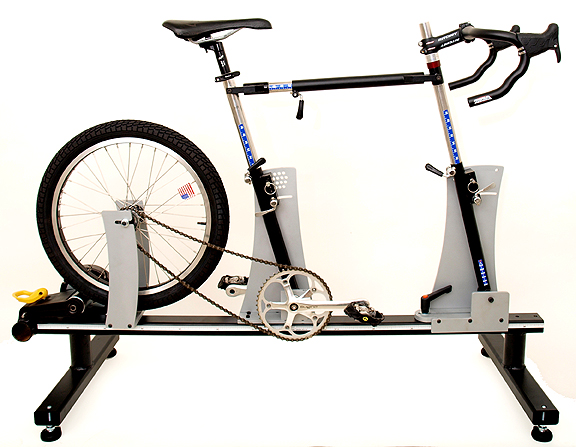
Fitting Systems: Let's suppose, however, that you don't feel confident about measuring a bike (or yourself) and just want to have it done for you. There are a couple of bike-fitting hardware systems sold to bike shops whose personnel are usually certified to use them. Perhaps a shop in your area has one of these systems:

Bike Fit Kit: The "Fit Kit" sold to cycle shops to determine bicycle fit. Since they sell the kits, they don't "give away" their methods online, but visiting their site is interesting in what it says about their approach.

The Fitmaster is the all-in-one fitting machine seen in many bike shops. Shops in at least 25 states in the US have these. A nice, integrated system combined with training on how to use it. This is a good investment for any bike shop, it would seem.

Some randomly-chosen services using (probably) one of the above systems are listed below:

Ride Boutique is certified on several different fitting systems. If you live near Ann Arbor and have a couple of Benjamins to spare, this might be time (oh, yes, and money) well spent.

Papa Wheelie's bicycle shops (again, I love that name) in Boston and Portsmouth, NH also has advanced fitting services. They mention the magic word, "chondromalacia," which I suffer from.

Bicycle fitting services in Tampa, FL. Seem reasonably priced.

eBooks: Lastly, you may simply be a book person, and the comfort of the printed page (that is, if you're willing to print it yourself, as these are ebooks) is the way to go for you. (I can certainly understand this.) There are a couple of titles that come to hand, based on my Internet search:

Arnie Baker's "Bike Fit" ebook. If you're a learning-oriented, self-reliant kind of person, this may be for you. A whole lot less expensive than a fitting session, too.

Andy Pruitt's Medical Guide for Cyclists. Ebook. Combines a section on bicycle fitting with a section on injuries / prevention / care.

Monday, August 31, 2009

Cyclist's Log, and A Bargain

First: Mileage at the end of August: 2548. This is 463 miles this month. It would have been more, except for that little 4-day vacation to the Rhode Island shore. But I'm well on track to smash my yearly goals, so no complaints here. Especially not now that the weather is drying out and getting cool both in the morning and evening.

Let's get to a late-breaking item, though, and that is a quality bike available at a bargain—at least, if you are in the market for a practical "urban" bike (that is, I think, the new "third category", after "road" and "mountain".) I don't advertise on this blog, and this is not an ad, just a heads-up on a bike that I'd buy for myself if I needed an urban warrior.

REI has their venerable Transport Bike on sale (must be time for a hardware upgrade) for only $480. This is a bike that has won awards for the best commuter from Bicycling magazine. Internally geared 7 speed rear hub and front dyno-hub. Fenders, rack, lighting, all included. This is one of the very few bikes that I'd take nothing off of. (Well, maybe pedals.) If you're in the market for a practical bike, and especially if you have an REI store in your area (and double especially if you're already a member,) check out this bike. Heck of a deal, but good only, they say, 'til 7 September.

Friday, August 7, 2009

The Oregon Manifest troubles me...

Sometimes I worry that I'm becoming a curmudgeon. For example, take my reaction to the Oregon Manifest. Here is an event that, on the face of it, people like me should be wholeheartedly in support of. (I know, don't end your sentences with prepositions.) But still, I find it troubling. Bear with me as I explore the reasons why:

First, what is the Oregon Manifest? It's a three-weekend series of bike related events in October and November. There appear to be two main events: The Oregon Manifest Constructor's Design Challenge is a framebuilders' competition aimed at [inspiring] "frame builders and designers to develop considered, integrated, and spectacular solutions for the everyday rider". Complementary to this is the second major event, the Constructor's Race, wherein "Design Challenge builders (or their designated proxies) will put their entries to the test braving dirt, gravel, elevation climbs, and urban technical trials on the route to Bike Victory."

The judging criteria for the Design Challenge is truly broad and deep. From the entry form, it reads like this:
  1. Truly sensational solution: A genuinely unique and innovative solution for transportation use. Amaze us.
  2. Handling: The bike must handle equally well with and without load. Both options will be tested against turning and straight pedaling.
  3. Integration: Design solutions should be integrated into a complete and harmonious whole, rather than a checklist of details.
  4. Presentation and Execution: Fabrication refinement and final presentation are important indicators of skill and thoughtfulness. Extraordinary craftsmanship can be displayed equally well in the simplest brazing or the fanciest lug. Individual design solutions should build to a single visual and functional whole.
  5. Overall response to the course and challenges: Entry bikes must take into consider all elements of the race course, the 10 design considerations and the overall challenges they present.
  6. Load carrying: Bikes must accomodate and securely carry the rider’s award ceremony party attire, a provided 6-pack of beverage (in glass bottles), and a provided small container of party snacks.
  7. Security: Bikes must be protected from theft while unattended. A smart, easy solution for securing the bike under different conditions is expected.
  8. Portage: Bikes must accommodate being carried by its rider over a section of the course.
  9. Utility: Bikes should accomodate the expected need for changing weather, lighting conditions, and visibility. We know that you know what this means.
  10. Quality and Rattles: If elements are loose, rattling, or otherwise inoperable at the race finish, points will be deducted for each failure.
So, there you have it. Everything from "Amaze us" (and "us" is a distinguished group of judges) to "smart, easy solution" for security to "accommodate weather" to "no rattles". You will agree that that's a broad portfolio for design and execution, no?

You know, I do believe that issuing a tough challenge is a good way to get results. I've participated in (and, on occasion, won) design challenges under tough, even unreasonable, conditions. So, what problems could a Practical Cyclist have with such a challenge? I think my problem is with the assumptions that this event appears to make about the state of affairs "for the everyday rider" (and I feel that, as a bona fide "everyday rider" and as a blogger who cares about bicycle design I get to weigh in on this stuff):

Assumption 1: The reason people don't use bikes for transportation is that the bikes themselves aren't good enough, nicely-enough designed, practical enough, or (especially) convenient enough. This is a seductive assumption: "Hey, if we could just make bikes convenient, like cars, people would use them!" Well, I hate to be the one to break this news, but it's just not going to happen -- bikes will never be as convenient as cars, and we'll just have to live with that. The truth is, the not-so-little problems with bike "convenience", to wit,
  • safety in traffic
  • weather
  • security
  • comfort
  • physical stamina
  • efficient power utilization
  • perspiration
..can be addressed by physical bicycle design only to a limited degree. The problems that can't be addressed by design will have to be overcome by preparation and motivation to ride, and I assert that it is lack of motivation to ride that keeps people off bikes, because, frankly, bikes are pretty wonderful as they are. Making them 2 or 3 or even 5 percent more wonderful is nice, but hardly a revolution.

Assumption 2: A 77-mile cyclocross race is a predictor of a successful transportation system. Look, practical transportation needs are in the range of 20 to 30 miles a day, maximum. And they don't involve portage or dirt trails. (They do involve carrying lunch and a change of clothes, however, which is admittedly also part of the challenge.) Cyclocross races, especially ones with extra "degrees of difficulty", are fun, for sure, but suggesting that an event like this has anything to do with the "everyday rider" is muddying the waters.

Assumption 3: The engineering and fabrication required to solve the problems stated in the design brief can be done in 2 months. I've built frames before; 30 years ago in Houston, I had the great privilege to be an apprentice to the late, great Roman "Ray" Gasiorowski, maker of Romic bikes. From my personal experience, to even begin to solve these problems, you're talking about a month of pencil-and-paper work. Then fabrication of special components, then assembly and testing. The timing is such that what you're going to get is a bunch of beautiful, well-engineered, fast cargo bikes. This is not a bad thing, mind you, but not "velorutionary". (Here's a prediction: several of the entrants, and probably the winner, will use a Rohloff Speedhub, because of its superior transmission capabilities.)

Conceptual problems aside, though, I do see one other problem, or should I say potential conflict, and that is this: The listed Director of Oregon Manifest is someone named Jocelyn Sycip, and one of the listed entrants in the design competition is Sycip Design of Santa Rosa, California. Is this a conflict of interest, or am I to believe that the Sycips of Oregon and California are unrelated?

Yep, all these years and miles of bicycle commuting are turning me into a curmudgeon. No doubt about it.

Friday, July 3, 2009

Online Bike repair guides

In the old days, when there weren't so many bike shops and the Internet was a green-screen geeks-only paradise that offered only email, FTP, and Usenet discussion groups, getting information on how to fix your bike was difficult. Bicycle repair was a matter of lore, and virtually all serious riders were competent mechanics (at least to a degree.) For the first 20 years of the Tour de France (1903 - 1923), a rider was in fact required to do his own repairs. (Thanks Chairman Bill.) Perhaps this custom that riders be self-sufficient is why John Forrester's seminal book Effective Cycling has so many of its pages dedicated to bike maintenance and repair.

Now, of course, if you don't want to get your hands dirty, it's a quick trip down to the local bike shop to get that drivetrain fixed or those brakes adjusted, or maybe even a trip down there to get diagnosed what is wrong in the first place. This is fine if you have the money, or lack a mechanical aptitude gene. (It also keeps the local bike shop in business, which isn't a bad thing either.) So you, dear reader, have choices, and an excellent choice is an on-line bicycle repair website. The web is full of them, some good, some very good, and some quite generic (the "generic" ones are the ones that list "bike repair" up alongside "gutter repair" and "13 uses for baking soda".) I've surveyed several of the bike-specific sites here and hope you find the overview useful:

Park Tools Repair Site:
This ia an encyclopedic, professional bike repair web site. Not surprising when you consider the source -- Park tools have a deservedly excellent reputation and there's no better way to sell and support tools than to show people the proper way to use them. The Park website has a nifty interactive Flash-based "bicycle map" that hightlights the parts of the bike that may need repair and navigates you to the "chapter" of the website where you can see the specific topics on that part.

Bikewebsite.com:
This website is very old-school. It has a chaotic layout, with ads sprinked about. Topics are hit-or-miss. The illustrations are both sparse and of marginal quality, looking like they were created with a DOS-based paint program on a VGA screen. There are a few interesting sections, though, including a section that deals with diagnosing what's wrong with your bike based on how often you hear noises.

Bicycletutor.com:
This is easily the most "social web" oriented of the repair sites. Most if not all instructions include downloadable videos. Note the "tags" below the image-map of the bike at right. All instructions allow comments by users. This site has some general topics, such as "how to shift gears" and "how to tune up your bike", as well as the specific highly-categorized topics.

Utah Mountain Biking:
This site has a large selection of topics; each topic is well-illustrated with lots of well-cropped photos. I like that the graphic bike-parts index includes "Chad". Definitely a focus on mountain bike and downhill stuff here -- this is the place to go to get info on disk brakes and shocks.

Jim Langley's Bicycling Site:

This is definitely an "old-school" site with a pleasing personality. Lots of old-bicycle-poster eye candy, lots of mini-articles about bikes, with a focus on antique bikes. He does have a page calling out bike terminology, but unlike the other sites, he doesn't use this as a clickable index. This won't suit everyone, but the information given, although you may have to hunt around a bit to find it, is good. He has a number of topics on bicycle fit and adjustment.

Sheldon Brown's Fixit Pages:
The late, great Sheldon Brown of Massachusetts' Harris Cyclery had a collection of pages on the Harris website. The range of topics is by no means encyclopedic, in fact it's hit-and-miss, but if Sheldon Brown covers a topic, it's worth taking a look, because the depth of his topics is extreme (including things about the history of each component, going back to the English/ French/ Italian standards of the 1950s). Each topic is more like a brief "white-paper" style treatise on that kind of bike component or situation. For the experienced cyclist, this will be elucidating and enjoyable, but it's not for beginners who are looking for a "step-by-step" approach.

Wheelpro Wheel Building Guide:

I'm going to wrap this up with a single-topic website, or rather, a reference to an excellent book on perhaps the most important maintenance / repair topic, and that is wheels and wheelbuilding. Roger Musson, a British bicycle wheelbuilder and mechanic, has written the final word on building bike wheels.

It's not free, but neither is it expensive, and it comes with a money-back guarantee. It's packed with useful information and guarantees you that if you follow the instructions, you can build a wheel that will be straight and true for its lifetime (i.e., until the rims wear out.) If you like riding on round, true wheels and want to build wheels that are better than those you can buy, this is the reference for you.

Summary Chart:
For those of you who have made it this far, here's a chart summarizing the topics covered in all the sites listed. Click the image for a high-resolution, printable version.

Sunday, June 21, 2009

Apple and bikes

Continuing on in the "what if XX made a bike" series, let's take a deep breath and go after the big one: Apple.

Prologue: Today's state of bicycle "captial D" design to my mind is so-so at best. The fact that opportunity still exists for Apple to come in to the market (should they decide they want to) means that design is still lagging, despite all the effort put towards it. At right is a "design" put forth by Puma, a design-conscious fashion clothing manufacturer, for their fourth-generation bike. They appear to be making some kind of statement about color, except they can't quite get even that right (ahem, guys, get a white handlebar, stem, and front rim, and powder-coat the front brake calipers! If you're going to make it about color, DO IT!)

If Apple made a bike, what would it look like? Knowing what I know about Apple (I've been a Mac user since 1984 and have worked for 10 years for Nemetschek North America, makers of Vectorworks, the best-selling CAD product on the Mac), and particularly considering its recent successes with industrial design since the iPod, here is what I could reasonably predict about any Apple product:
  • It would be iconic; recognizable as the thing that it is (that is, it would be a realization of a classic design rather than a revolutionary design.)
  • It would feature obsessive attention to detail.
  • It would focus on the user experience.
  • It would definitively fix problems with the product category that users didn't realize they had.
  • It would be visually beautiful and a tactile delight.
  • It would co-promote other products made by Apple as part of a lifestyle.
  • It would be expensive, a stretch for the pocketbook; something that conveys status, but stops short of aloofness.
  • It would be value-engineered, so Apple could make a decent profit.
  • It would be sold only through the Apple store. (duh.)
  • There would be tremendous opportunity to create a third-party "add-on" ecosystem.
So, how would these "branding requirements" translate into a specific bicycle design? What are the "unrealized problems" waiting to be solved in bicycle design that could be fixed with an obsessive amount of user-centric problem solving and delivered through industrial design? I think the major problems to be solved (the "user requirements") are these:
  • Looks: The bike should have a minimalist look, as much like a fixie as possible. The explosive popularity of fixies is all about that sexy, iconic bike look.
  • Shifting: Bikes need to be easier to use (i.e. shift) so that users don't wear themselves out getting from point A to point B. (Fixies look great, but aren't practical unless you're an athlete.)
  • Security: There needs to be a convenient, highly effective anti-theft solution.
  • Comfort: The places where your body touches the bike, the controls, the seat and the pedals, need improvement. This is after all the "user interface" of the bike. Ideally, other than for a helmet (and maybe some sporty-looking gloves) you wouldn't need any special clothing to use this bike.
  • Maintenance: The thing needs to set new standards of minimalism in maintenance.
Specking out this bike (at a high level) would be fun—more fun, I daresay, than the sweat-work of designing and testing it. (So, let's do it!) I would think we'd see the following kind of "functional specification" from Apple in trying to fulfill these requirements:
  • Frame: Probably hydr0formed aluminum, welded, with smooth-dressed joints. The finish would be anodized ("nanochromatic" colors to match the iPod nano?) and clear-coated. All cables would be internally routed. The frame would be set up so that a minimum number of sizes (maybe just two: small and large) would accommodate all riders. This presumes a maximally adjustable seatpost and stem arrangement.
  • Drivetrain: Internally-geared rear hub, probably 8 speed, with an automatic shifter working off cadence and speed scnsors integrated in the frame. Belt drive. Gear range for city hills.
  • Brakes: Internal hub brakes front and rear. (Yes, the hubs will be big, but it'll be a clean look and low maintenance. Speaking of which...).
  • Maintenance: Carbon or aramid drive belt good for 10,000 miles. Sealed bearings everywhere. Aramid-belted tires (possibly tubeless) with interior goo to stop slow leaks. All cables Teflon-coated. An absolute minimum of hardware exposed to the elements. Here's where that famous Apple attention to detail will pay off.
  • Controls: Brake handles with fully-concealed cabling. The cyclocomputer would be your iPhone or iPod touch running a "free" app from the App Store. The app would integrate GPS, speed, odometer, traffic and weather reports, and (naturally) music. There would be special valve-stem caps that could sense low pressure in your tires and transmit warnings to the control unit via Bluetooth. Oh, and the app would enable customization of your shift points on the transmission. The front hub would be a dyno-hub to keep the lights and the iPhone charged up.
  • User Interface (pedals, seat, handlebars): I think Apple could come up with some clever platform pedals that would work with street shoes but still have some restraint to allow pedaling efficiency. And the handlebars should be "fixie" style, perhaps with cell-foam padding so they could be used without gloves. The saddle is the real problem, because it needs to fulfill two conflicting requirements (1) be an iconic bike saddle; and (2) be comfortable. I think they'd have to do something like provide a "basic" saddle that has a proven comfort record like the Terry Liberator, and a "premium" saddle that is a Brooks classic leather saddle that comes fully broken in. (That will be an expensive extra cost option!)
  • Accessories: I think fenders, yes; but rack, no. (Fenders are sexy, racks aren't.) Instead of selling racks and panniers, Apple could sell coordinated backpacks (they could re-brand this ergonomic German one). Lights front and rear, for sure, integrated into the frame. The really tough challenge is the security issue. You could easily design security to work for Mudville, but not so easy for Manhattan. And effective locks are so big and heavy. I think Apple might try a two-pronged approach: first, a frame design that integrated a solid locking bar that would allow you to use a small high-security lock rather than a U-bar lock, and secondly, something (again an extra cost option) that worked with the iPhone to transmit a "help" signal if the bike were being tampered with.
Whew. Quite a bike, huh? What should it sell for? I would say that it ought to sell slightly above the price range for Apple laptops, say $1900 to $3500 depending on the options. I daresay that Apple has enough economies of scale, manufacturing wise, to be able to pull this off, and to value-engineer it to make a profit. (That auto-shifter will be tricky to engineer for sure, but Apple's just the company to do it.)

An industrial designer who is really ready to take on the challenge of the Apple bike is the Swedish designer Erik Nohlin from Gothenburg. He entered his delightfully minimalist, well thought out "MuskOx" design in the Bicycle Design (blog) "Ultimate Commuter Bike" design contest. (He should have won in my opinion.) If Apple wanted to get into bikes, they should just hire this guy, give him the list of requirements, and fund him.

But, first things first, Apple. Before you can proceed on this project, you have to wrestle the "iBike" trademark (#3096850) away from Velocomp LLP, makers of the "iBike" cyclocomputers.

Sunday, June 14, 2009

Disc Brakes

... or is it Disk Brakes? Anyway, I've never understood the use of disc brakes on anything other than a mud-eating mountain, downhill, or (maybe) cyclocross bike. The brake-choking mud or dirt seems to me to be a requisite to justify it.

Why is this? The reason is simple, if you have an interest in amateur physics (and I do): Braking Torque. Think of it this way: if the braking is occurring at the hub (as it is with a disk brake), then all the braking force has to be transmitted from the hub, through the spokes, to the rim (where after all, the "rubber meets the road.")

This means that the spokes (which are the weakest link of the wheel) do at least twice as much work on a bike equipped with disk brakes. I haven't seen statistics for this, but I'd be willing to bet that spoke breakage is higher on bicycles equipped with disk brakes. I also wonder if there is a higher rate of failure of the seat stays (which absorb braking force), since the force applied by the disk brake is several times higher than a rim-caliper brake. (see illustration)

On a rim-brake setup, you can think of the entire wheel as the "disk". Braking force is less, but more importantly, the braking force is being applied near the rim, and the only loads that are carried by the spokes are for driving force (which are inevitable) and structural (keeping the wheel true and round).

As long as the wheel is in fact true, and you can properly keep adjusted your rim-caliper brakes (of whatever type), They are a physically and structurally superior solution. It does require that you keep your wheels true, but I'm sorry, if you have wobbly wheels, your riding quality is going to be pretty poor no matter what. I will grant that using the rim for braking means that the rim is eventually going to wear out and you'll have to replace the rim (rebuild the wheel), but we're talking tens of thousands of miles here.

Of course, bike manufacturers are loading up their offerings with disc brakes, even for bikes that will never see off-road use (and of course many so-called "mountain bikes" will always be on a paved trail.) Here's an offering from Raleigh, here's one from Trek, here's a Civia, and even REI has one. These are all touted as premium bikes in their categories. But bear in mind that the disk brakes, while superior in an automotive setting, don't convey that much superiority in a bike that won't be used on unpaved trails.

Give me old-school cantilevers any time. They require some hand strength, but they never fade, and boy are they reliable.

Update: The excellent "Cozy Beehive" blog has a report on a disc brake induced failure here.

Tuesday, June 9, 2009

Buying a used bike: "Beaters"

I was going to make a post on buying a used bike on Craigslist; what to look for and what to avoid and all that. But the New York Times, bless 'em, has done a better job at this than I could on an article about Beater Bikes. Check it out.

Sunday, May 10, 2009

IKEA and bikes

This past weekend, I passed the architect's equivalent of the "busman's holiday", which is, I spent two days in New York City assembling IKEA furniture for my younger daughter who is moving into her own apartment in NYC to take her first job. (Big milestones, you will I hope agree, and particularly poignant on Mothers' Day weekend.)

I am continually impressed with IKEA's value-engineering of their product. Their simple idea is to deliver good design at the least cost. In this case, "good design" means not only visual appeal but also sturdiness without excess weight or material. These are big challenges also for bicycle design, and IKEA stands out as the world-wide champion of achieving this.

Their approach to value-engineering is relentless, and if you assemble (as I did) eight pieces of furniture and observe their VE technique, it's quite remarkable. In eight pieces of furniture, there was only one mistake in execution (a wrong-handed drawer glide was supplied.) The newer pieces used a composite, rather than all-metal, cam-lock mechanism that was lighter, cheaper (no doubt) and held just as tightly as the old all-metal ones. Perhaps most remarkably, in not one of the pieces I assembled (and I did everything from bookcase to desk to dining table to futon) was there either a hardware piece missing or extra.

It's extremely tempting to ask the question, "If IKEA made a bike, what would it be like?" I'm guessing the specs would be something like this:
  • Two-piece reinforced resin 6 spoke wheels;
  • Sealed press-in cartridge bearings everywhere;
  • One wrench required to assemble the whole thing (probably 6mm);
  • Internally geared 3 speed rear hub assembly, in-hub drum brakes front and rear;
  • Single frame size (also reinforced resin or possibly TIG-welded aluminum);
  • Size adjustments with extra-long, cuttable seatpost;
  • Some innovate approach to a fork (maybe a motorcycle style double-post fork with resin crossbars) to eliminate the expensive headset arrangement;
  • Single-chainwheel crank with either belt drive or lifetime lube chain;
  • Standard saddle and pedal attachments to allow for customization / replacement;
  • One-piece (i.e. non-demountable) bars, grips and brake lever assembly.
All flat-packed and user-assembled, of course. The price would I think be in about the $300 range. It's doable with the current technology (and with the VE technology that IKEA has already assembled.)

Then they should sponsor a team in the Tour. (I'm surprised they don't already -- they must have more money than God.)

Friday, April 24, 2009

AIA-SFO: Integrating Bikes and Business

Next week I'll be attending the American Institute of Architects (AIA) convention in San Francisco. Architects are (at long last) becoming environmental leaders in the professional communities, and "cycling" and "environmental" fit together nicely for me, so I'll be taking a folding bike to push the envelope of "green consciousness" for architects. I don't want to be unfair here—I've noticed that there exists a large intersection among architects, cyclists, and (even) bike builders, it's just that, when it comes to cycling, and particularly practical, everyday cycling, there's a lot more lip service than action. So I hope to turn that around in a small way.

My company, Nemetschek NA, produces a computer-aided design software called Vectorworks. It's used primarily by architects (as I am), but it has great 3D and solids capabilities, and I want to design bikes with it. (This would be just another integration of life, work, and avocation for me.) I've designed buildings and shoes with it, but not yet bikes. If you've used CAD to design bikes, I want to talk to you, so leave me a comment and a way to get in touch!

San Francisco is a city where I've spent time before. And it has hills that are serious challenges to walk up, much less bike up. I don't think I have a bike set up with the gears needed for all of San Francisco.

That's the bad news. The good news is, I'm going to be spending almost all my time in the "SoMa" (South of Market) area, which is quite flat, by SFO standards. Following one of the guiding principles of Practical Cycling, "Research your Route", I've done some homework on SFO. Here's a nifty topographical map of the city overlaid with bike routes. Below is a Google map of what I'm going to be up to. The aqua-colored destination in the middle of the Castro district is where my friend Scott and his wife Polly reside, and that is at the top of a pretty awesome hill, one I don't think I'd try and tackle unless I had about 22" gears. So Scott and I will have to meet elsewhere (maybe at the "Zeitgeist" bar, which is I'm told a favorite of the local bike couriers), or I'll take the bus to his house.


View SFO AIA Convention 2009 in a larger map

So, I've decided to take my folder for the flat areas. I bought (off my brother, who wasn't using it) a Dahon "Speed D7" folder, (mine being about 8 years old, not quite as nice as the one in the link), and a Samsonite "Oyster" standard-airline-case (SAC) that it fits in for transport. I spent a weekend overhauling it, getting it properly equipped for minimal practical cycling (tool kit, pump, lock, patches, lights,) and learning how to pack it. (I made some breakthroughs in this area. There are websites that state that you can't pack a Dahon folder in an Oyster without removing the stem and handlebars, a major pain since I added a cyclocomputer mount. I found that I need only remove the wheels, and everything else fits neatly. (I'll leave the details of that for another post.)

I was in Seattle at the beginning of April and used the trip out there as a first shake-down trip for the travelling cyclist use-case. Excepting a tangled chain on initial unpacking of the bike, everything went surprisingly well. I found the little Dahon, while a bit short in the leg for my tall frame, to still be an acceptable ride for up to, say, 20 miles. I put about 75-80 miles on the Dahon in 5 days, in Seattle, a city not devoid of hills itself. The gear range is rather limited, at both the top and (somewhat surprisingly, given the 20" wheels) the bottom.

So, if you're in San Francisco next week and see the very tall guy on the clown bicycle wearing the Vectorworks shirt, that will be me. Flag me down and tell me you're a reader of A Practical Cyclist, and I'll be glad to invite you to the Vectorworks "City to Green" party on Thursday night! And if by chance you're attending the AIA convention, please drop by the Vectorworks booth, #1651, and let's talk bicycles, design, and computer-aided design.

Tuesday, April 7, 2009

Bike Ownership Patterns and Cyclo-computers

It's funny, you know. There seem to be two different types of bicycle owners. The first kind has one bike. Maybe he or she personalizes it, gives it a name. The second kind of owner owns several bikes: maybe a road bike, maybe a fixie, maybe a twenty-niner, maybe a folder, maybe a vintage 70's model. Either kind of owner can be a dedicated rider or not.

But in the case of the second type of owner who happens to be a dedicated rider, there's a market need going unfulfilled, and that is, cyclo-computers with more than two available wheel size settings. They just don't exist as far as I know. The multi-bike example I gave above (and honestly, from perusing the blogosphere, I don't think this is such a rare occurence) could have 4 different wheel sizes on his bikes.

Later this year, as I rebuild my beloved touring bike, I will be in a situation where I have bike with 3 different wheel sizes, and I will be forced to go to wheel reset mode on a regular basis if I want to properly accumulate mileage (and I do.) I'll bet that the desire to have a reasonably accurate cumulative mileage (coupled with the ability to learn one and only one set of controls) would be highly attractive to a growing market segment.

So here's a great opportunity, all you manufacturers of cyclocomputers (and there's probably only about three, maybe four, of you) -- give us some flexibility!

Sunday, March 8, 2009

Bag Security / Laptops

Marcus Sanford, one of the two co-editors over at the Austin on Two Wheels blog (see my blogroll), has just experienced a major equipment failure with a pannier which failed to protect his laptop, and he cracked his screen as a result. Read the story here.

My condolences to Marcus. I think that bag security is a major issue for commuting cyclists. I, like Marcus, carry my laptop in to work on a daily basis. Until early last year, I wore a padded laptop backpack to do so. However, I changed over to large touring panniers that are large enough to actually take the padded backpack inside. Although initially somewhat improvised, this has proven to be a quite workable solution.

Marcus' experience was that the laptop pannier he chose (the Axiom "Transition") didn't have an obvious (or documented) lock-down mechanism to guarantee that the pannier wouldn't fly off the rack. (His dispute with the Axiom company is that they did in fact have a locking device, but failed to inform the users about it! I can't blame Marcus for being heated.)

My big panniers sit far back on my rack, to make room for my big feet. They are secured with hooks, with heavy elastic tie-downs, and (as a backup) with Velcro safety straps that encircle the top rails of my rear rack. (See the image.) If the panniers that you use on your bike have a comparable safety device, use it, even if it takes an extra moment to do. (Marcus will tell you it's worth it.)

Although these are by no means expensive bags, (they're the Nashbar house brand), they get the job done. They are plenty big (and that's a major virtue), and they are soft and kind of floppy, so that abrupt bumps are "suspended" by the flexibility of the bag itself. I've hit many bumps over the 3,000 miles of last year, and no major accidents yet. It's also a major advantage that, if I park my bike, I can easily lift out the backpack with my laptop, and carry it with me comfortably.

I do consciously think about my bags. I look back at them at least once on every commute. If I see them swinging about, I stop and check attachments. So far, so good.

PS: End of the first week of March, and I'm now at 500+ miles. Woo-hoo!