Showing posts with label gadgets. Show all posts

Friday, October 16, 2009

Bike fitting

Bike fitting, buying and finding and adjusting a bike to work well with your body, your flexibility, your strength, and your needs, is an important topic. Today I've put together a post that covers some of the online resources for bike fitting, and also briefly discusses fitting services and systems.

On-line Guides: First I'll give a brief survey of some of the online fitting guides. At top right is a chart detailing the topics covered by these sites:

Rivendell Bikes has a nice online guide for choosing a bike. This is predominantly a guide for choosing a frame size, based predominantly on pubic bone height (AKA "inseam"). It has an interesting rule for how to determine the leaning angle of the torso. This is oriented towards comfort and not racing sizing (which really is not addressed by any of these sites.)

Bikerowave (love the name) has a pretty plainly presented (looks like a forum entry) discussion, but the information there is good.

Jim Langley's excellent site has made the posts of this blog before. He presents fitting as a troubleshooting guide. Good if the bike you already own falls within the range of what you need, not so useful as a buyer's guide. (Langley quotes from Ivan Illich -- hm, good topic in itself for some future post.)

Kirby Palm's long discourse on bike fitting is encyclopedic. Anyone who can write this much on a topic probably knows something about his subject. If not, let's hope he gets lucky. Seriously, this is arranged in a somewhat wordy narrative, but is quite comprehensive and useful.

Peter White Cycles has a page on the topic. It provides some general advice on frame fitting as well as advice on selecting the kinds of merchandise Peter sells. (I really like Peter's site and sincerely appreciate the information he provides. I would buy from him a lot more if he made it easier to do so.)

The Colorado Cyclist site has a thorough (if not particularly broad) guide. It uses a step-by-step approach that I like in this kind of guide.

Wabicycles has a frame-spec focused site that is oriented toward fixies. It information is compactly organized and not unsophisticated. Definitely the place to go if you're thinking about converting that old Raleigh from the '70s into a fixie.

Fitting Systems: Let's suppose, however, that you don't feel confident about measuring a bike (or yourself) and just want to have it done for you. There are a couple of bike-fitting hardware systems sold to bike shops whose personnel are usually certified to use them. Perhaps a shop in your area has one of these systems:

Bike Fit Kit: The "Fit Kit" sold to cycle shops to determine bicycle fit. Since they sell the kits, they don't "give away" their methods online, but visiting their site is interesting in what it says about their approach.
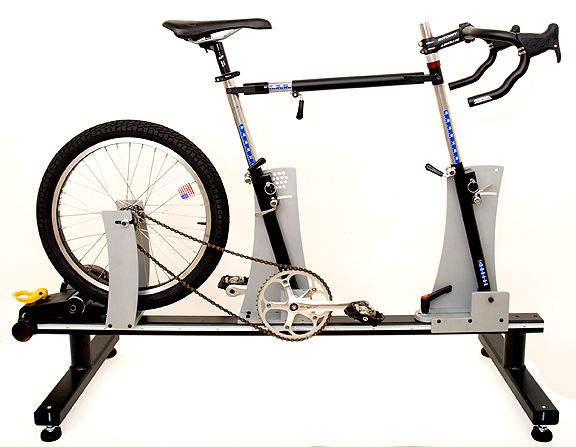
The Fitmaster is the all-in-one fitting machine seen in many bike shops. Shops in at least 25 states in the US have these. A nice, integrated system combined with training on how to use it. This is a good investment for any bike shop, it would seem.

Some randomly-chosen services using (probably) one of the above systems are listed below:

Ride Boutique is certified on several different fitting systems. If you live near Ann Arbor and have a couple of Benjamins to spare, this might be time (oh, yes, and money) well spent.

Papa Wheelie's bicycle shops (again, I love that name) in Boston and Portsmouth, NH also has advanced fitting services. They mention the magic word, "chondromalacia," which I suffer from.

Bicycle fitting services in Tampa, FL. Seem reasonably priced.

eBooks: Lastly, you may simply be a book person, and the comfort of the printed page (that is, if you're willing to print it yourself, as these are ebooks) is the way to go for you. (I can certainly understand this.) There are a couple of titles that come to hand, based on my Internet search:

Arnie Baker's "Bike Fit" ebook. If you're a learning-oriented, self-reliant kind of person, this may be for you. A whole lot less expensive than a fitting session, too.

Andy Pruitt's Medical Guide for Cyclists. Ebook. Combines a section on bicycle fitting with a section on injuries / prevention / care.

Monday, September 21, 2009

It's a "Bike" only because it has two wheels...

Here's the "Yikebike", a Kiwi-designed transportation device that is going to get a lot of press as the successor to the Segway. In some ways, it's a worthy successor. Here's the remarkably well-produced marketing movie, replete with Europop-music, neon-green contrail, and catchy phrases.

The Yikebike is a foldable, baggable, portable, minimalistic electric transportation system. It's not an "E-bike", at least insofar as there is no way to pedal the thing when the battery runs out. It's not high-performance, as most average-to-good urban cyclists could whip it soundly over a short course of a couple of city blocks.

The "YikeBike" has been getting more coverage on gadget blogs than on cycling blogs, and this is for good reason. (It's not, after all, a bicycle as we think of it.) Here are some pertinent specs:
  • Range: 9-10 kms (5.5-6.3 miles);
  • Payload: 100 kg (220 lbs.) including baggage;
  • Charging time: 20 mins for 80% charge;
  • Charging cost: $0.15-0.20;
  • Vehicle weight: 10 kg;
  • Cost: Between $5200 and $5900.
There's a lot to like about the YikeBike concept, especially its product design. The folding design is top-notch, really well thought-out, and clever to boot (I love the "penny-farthing" iconography combined with the "Keep-on-Truckin" posture of the rider). The unit, when folded, appears to be actually compact enough to sling over a shoulder in its special bag. The steering system is compact, innovative, and (at low speeds at least appears to be) effective. The marketing (so far) is quite catchy. But as a serious alternative to bicycles (and let's be fair, it does present itself as such an alternative in its movie), it fails. The range is too short as an alternative to cycling (my daily commute is twice the YikeBike's range each way), and certainly too short as an alternative to car-commuting (which it also tries to undertake).

This raises the problematic question: if the YikeBike isn't a serious alternative to cycling or aut0-commuting, what is it an alternative to? The uncomfortable answer: walking. Walking on a very short commute, or walking to and from the bus-stop. Not even an e-bike purports to replace walking, typically they replace hill-climbing. (And that's fair enough, I suppose.) E-bikers will actually pedal on the flats, extending their range indefinitely, although too bad for them on the climbs when the juice runs out.

I say we need more walking, not less, and therefore I predict the YikeBike will join the Segway in the pantheon of vehicles for sore-footed tourists who want to do extended-range walking tours in urban settings. There are a lot of good design ideas there, though.

Postscript: what do I really, really, really like about the YikeBike movie? Check it out. The uber-cool YikeBiker is wearing Chuck Taylor All-Star Black Monos. This is the ultimate shoe in the world. It can be worn anywhere: your local skateboarding park, a cocktail party, with a tux to an opening at the Kennedy Center. It's green, recyclable, and your yoga teacher will like it, because it folds and gives your feet an opportunity to learn how to Walk Right. I own two pair (one high-top and one low) and am happy to bestow on them the Practical Cyclists' Seal of Approval. (Now if Converse only made them SPD compatible!)

Friday, July 3, 2009

Online Bike repair guides

In the old days, when there weren't so many bike shops and the Internet was a green-screen geeks-only paradise that offered only email, FTP, and Usenet discussion groups, getting information on how to fix your bike was difficult. Bicycle repair was a matter of lore, and virtually all serious riders were competent mechanics (at least to a degree.) For the first 20 years of the Tour de France (1903 - 1923), a rider was in fact required to do his own repairs. (Thanks Chairman Bill.) Perhaps this custom that riders be self-sufficient is why John Forrester's seminal book Effective Cycling has so many of its pages dedicated to bike maintenance and repair.

Now, of course, if you don't want to get your hands dirty, it's a quick trip down to the local bike shop to get that drivetrain fixed or those brakes adjusted, or maybe even a trip down there to get diagnosed what is wrong in the first place. This is fine if you have the money, or lack a mechanical aptitude gene. (It also keeps the local bike shop in business, which isn't a bad thing either.) So you, dear reader, have choices, and an excellent choice is an on-line bicycle repair website. The web is full of them, some good, some very good, and some quite generic (the "generic" ones are the ones that list "bike repair" up alongside "gutter repair" and "13 uses for baking soda".) I've surveyed several of the bike-specific sites here and hope you find the overview useful:

Park Tools Repair Site:
This ia an encyclopedic, professional bike repair web site. Not surprising when you consider the source -- Park tools have a deservedly excellent reputation and there's no better way to sell and support tools than to show people the proper way to use them. The Park website has a nifty interactive Flash-based "bicycle map" that hightlights the parts of the bike that may need repair and navigates you to the "chapter" of the website where you can see the specific topics on that part.

Bikewebsite.com:
This website is very old-school. It has a chaotic layout, with ads sprinked about. Topics are hit-or-miss. The illustrations are both sparse and of marginal quality, looking like they were created with a DOS-based paint program on a VGA screen. There are a few interesting sections, though, including a section that deals with diagnosing what's wrong with your bike based on how often you hear noises.

Bicycletutor.com:
This is easily the most "social web" oriented of the repair sites. Most if not all instructions include downloadable videos. Note the "tags" below the image-map of the bike at right. All instructions allow comments by users. This site has some general topics, such as "how to shift gears" and "how to tune up your bike", as well as the specific highly-categorized topics.

Utah Mountain Biking:
This site has a large selection of topics; each topic is well-illustrated with lots of well-cropped photos. I like that the graphic bike-parts index includes "Chad". Definitely a focus on mountain bike and downhill stuff here -- this is the place to go to get info on disk brakes and shocks.

Jim Langley's Bicycling Site:

This is definitely an "old-school" site with a pleasing personality. Lots of old-bicycle-poster eye candy, lots of mini-articles about bikes, with a focus on antique bikes. He does have a page calling out bike terminology, but unlike the other sites, he doesn't use this as a clickable index. This won't suit everyone, but the information given, although you may have to hunt around a bit to find it, is good. He has a number of topics on bicycle fit and adjustment.

Sheldon Brown's Fixit Pages:
The late, great Sheldon Brown of Massachusetts' Harris Cyclery had a collection of pages on the Harris website. The range of topics is by no means encyclopedic, in fact it's hit-and-miss, but if Sheldon Brown covers a topic, it's worth taking a look, because the depth of his topics is extreme (including things about the history of each component, going back to the English/ French/ Italian standards of the 1950s). Each topic is more like a brief "white-paper" style treatise on that kind of bike component or situation. For the experienced cyclist, this will be elucidating and enjoyable, but it's not for beginners who are looking for a "step-by-step" approach.

Wheelpro Wheel Building Guide:

I'm going to wrap this up with a single-topic website, or rather, a reference to an excellent book on perhaps the most important maintenance / repair topic, and that is wheels and wheelbuilding. Roger Musson, a British bicycle wheelbuilder and mechanic, has written the final word on building bike wheels.

It's not free, but neither is it expensive, and it comes with a money-back guarantee. It's packed with useful information and guarantees you that if you follow the instructions, you can build a wheel that will be straight and true for its lifetime (i.e., until the rims wear out.) If you like riding on round, true wheels and want to build wheels that are better than those you can buy, this is the reference for you.

Summary Chart:
For those of you who have made it this far, here's a chart summarizing the topics covered in all the sites listed. Click the image for a high-resolution, printable version.

Sunday, June 21, 2009

Apple and bikes

Continuing on in the "what if XX made a bike" series, let's take a deep breath and go after the big one: Apple.

Prologue: Today's state of bicycle "captial D" design to my mind is so-so at best. The fact that opportunity still exists for Apple to come in to the market (should they decide they want to) means that design is still lagging, despite all the effort put towards it. At right is a "design" put forth by Puma, a design-conscious fashion clothing manufacturer, for their fourth-generation bike. They appear to be making some kind of statement about color, except they can't quite get even that right (ahem, guys, get a white handlebar, stem, and front rim, and powder-coat the front brake calipers! If you're going to make it about color, DO IT!)

If Apple made a bike, what would it look like? Knowing what I know about Apple (I've been a Mac user since 1984 and have worked for 10 years for Nemetschek North America, makers of Vectorworks, the best-selling CAD product on the Mac), and particularly considering its recent successes with industrial design since the iPod, here is what I could reasonably predict about any Apple product:
  • It would be iconic; recognizable as the thing that it is (that is, it would be a realization of a classic design rather than a revolutionary design.)
  • It would feature obsessive attention to detail.
  • It would focus on the user experience.
  • It would definitively fix problems with the product category that users didn't realize they had.
  • It would be visually beautiful and a tactile delight.
  • It would co-promote other products made by Apple as part of a lifestyle.
  • It would be expensive, a stretch for the pocketbook; something that conveys status, but stops short of aloofness.
  • It would be value-engineered, so Apple could make a decent profit.
  • It would be sold only through the Apple store. (duh.)
  • There would be tremendous opportunity to create a third-party "add-on" ecosystem.
So, how would these "branding requirements" translate into a specific bicycle design? What are the "unrealized problems" waiting to be solved in bicycle design that could be fixed with an obsessive amount of user-centric problem solving and delivered through industrial design? I think the major problems to be solved (the "user requirements") are these:
  • Looks: The bike should have a minimalist look, as much like a fixie as possible. The explosive popularity of fixies is all about that sexy, iconic bike look.
  • Shifting: Bikes need to be easier to use (i.e. shift) so that users don't wear themselves out getting from point A to point B. (Fixies look great, but aren't practical unless you're an athlete.)
  • Security: There needs to be a convenient, highly effective anti-theft solution.
  • Comfort: The places where your body touches the bike, the controls, the seat and the pedals, need improvement. This is after all the "user interface" of the bike. Ideally, other than for a helmet (and maybe some sporty-looking gloves) you wouldn't need any special clothing to use this bike.
  • Maintenance: The thing needs to set new standards of minimalism in maintenance.
Specking out this bike (at a high level) would be fun—more fun, I daresay, than the sweat-work of designing and testing it. (So, let's do it!) I would think we'd see the following kind of "functional specification" from Apple in trying to fulfill these requirements:
  • Frame: Probably hydr0formed aluminum, welded, with smooth-dressed joints. The finish would be anodized ("nanochromatic" colors to match the iPod nano?) and clear-coated. All cables would be internally routed. The frame would be set up so that a minimum number of sizes (maybe just two: small and large) would accommodate all riders. This presumes a maximally adjustable seatpost and stem arrangement.
  • Drivetrain: Internally-geared rear hub, probably 8 speed, with an automatic shifter working off cadence and speed scnsors integrated in the frame. Belt drive. Gear range for city hills.
  • Brakes: Internal hub brakes front and rear. (Yes, the hubs will be big, but it'll be a clean look and low maintenance. Speaking of which...).
  • Maintenance: Carbon or aramid drive belt good for 10,000 miles. Sealed bearings everywhere. Aramid-belted tires (possibly tubeless) with interior goo to stop slow leaks. All cables Teflon-coated. An absolute minimum of hardware exposed to the elements. Here's where that famous Apple attention to detail will pay off.
  • Controls: Brake handles with fully-concealed cabling. The cyclocomputer would be your iPhone or iPod touch running a "free" app from the App Store. The app would integrate GPS, speed, odometer, traffic and weather reports, and (naturally) music. There would be special valve-stem caps that could sense low pressure in your tires and transmit warnings to the control unit via Bluetooth. Oh, and the app would enable customization of your shift points on the transmission. The front hub would be a dyno-hub to keep the lights and the iPhone charged up.
  • User Interface (pedals, seat, handlebars): I think Apple could come up with some clever platform pedals that would work with street shoes but still have some restraint to allow pedaling efficiency. And the handlebars should be "fixie" style, perhaps with cell-foam padding so they could be used without gloves. The saddle is the real problem, because it needs to fulfill two conflicting requirements (1) be an iconic bike saddle; and (2) be comfortable. I think they'd have to do something like provide a "basic" saddle that has a proven comfort record like the Terry Liberator, and a "premium" saddle that is a Brooks classic leather saddle that comes fully broken in. (That will be an expensive extra cost option!)
  • Accessories: I think fenders, yes; but rack, no. (Fenders are sexy, racks aren't.) Instead of selling racks and panniers, Apple could sell coordinated backpacks (they could re-brand this ergonomic German one). Lights front and rear, for sure, integrated into the frame. The really tough challenge is the security issue. You could easily design security to work for Mudville, but not so easy for Manhattan. And effective locks are so big and heavy. I think Apple might try a two-pronged approach: first, a frame design that integrated a solid locking bar that would allow you to use a small high-security lock rather than a U-bar lock, and secondly, something (again an extra cost option) that worked with the iPhone to transmit a "help" signal if the bike were being tampered with.
Whew. Quite a bike, huh? What should it sell for? I would say that it ought to sell slightly above the price range for Apple laptops, say $1900 to $3500 depending on the options. I daresay that Apple has enough economies of scale, manufacturing wise, to be able to pull this off, and to value-engineer it to make a profit. (That auto-shifter will be tricky to engineer for sure, but Apple's just the company to do it.)

An industrial designer who is really ready to take on the challenge of the Apple bike is the Swedish designer Erik Nohlin from Gothenburg. He entered his delightfully minimalist, well thought out "MuskOx" design in the Bicycle Design (blog) "Ultimate Commuter Bike" design contest. (He should have won in my opinion.) If Apple wanted to get into bikes, they should just hire this guy, give him the list of requirements, and fund him.

But, first things first, Apple. Before you can proceed on this project, you have to wrestle the "iBike" trademark (#3096850) away from Velocomp LLP, makers of the "iBike" cyclocomputers.

Friday, April 10, 2009

P.U.M.A.

This is too ironic. Here's a verbatim quote from the GM introduction of the "P.U.M.A." auto-balancing two person vehicle made in joint venture with Segway:

"Imagine moving about cities in a vehicle fashioned to your taste, that's fun to drive and ride in, that safely takes you where you want to go, and "connects" you to friends and family, while using clean, renewable energy, producing zero vehicle tailpipe emissions, and without the stress of traffic jams," said Burns. "And imagine doing this for one-fourth to one-third the cost of what you pay to own and operate today's automobile. This is what Project P.U.M.A. (Personal Urban Mobility and Accessibility) is capable of delivering."

Yes. Imagine that. Let's imagine this as a series of bullet points, shall we?
A vehicle:
• tailored to your tastes
• fun to drive and ride
• safely takes you where you want to go
• "connects" you to friends and family
• using clean, renewable energy
• producing zero vehicle tailpipe emissions
• without the stress of traffic jams

I say that my commute (which is to say, my bike) can robustly answer "check!" to all of these with the possible exception of the "connects you to friends and family" item which seems to me to be more like a cell phone than a vehicle. But my bike, maybe kinda sorta, can be said to do even this.

This whole thing beggars the imagination. I've accused GM of incompetence before (before this abomination, even well before the first bailout).

But the point is, really: What does the fact that PUMA can be taken seriously say about us as a society, anyway? Are we so culturally averse to physical activity (and to sweat) that we'll do anything to avoid it, as beneath us? The Roman poet Juvenal described the ideal of the "healthy mind in the healthy body"; the apostle Paul referred to the "body as a temple". It does seem that there is something particularly American about this; you don't see this aversion to activity in Europe. Can this be laid at the feet of Madison Avenue, who basically elevated BO (and therefore sweat) to the level of a mortal sin?

And, does that guy in the photo above have any notion of just how truly dorky he looks? I mean, didn't everyone see Wall-E?


Have we really, truly become South Park? (Thanks to Geeks are Sexy for the reference.) Man, I would feel so much better if I knew this were GM perpetrating an elaborate joke. But I don't think so; they're a week late.

Tuesday, April 7, 2009

Bike Ownership Patterns and Cyclo-computers

It's funny, you know. There seem to be two different types of bicycle owners. The first kind has one bike. Maybe he or she personalizes it, gives it a name. The second kind of owner owns several bikes: maybe a road bike, maybe a fixie, maybe a twenty-niner, maybe a folder, maybe a vintage 70's model. Either kind of owner can be a dedicated rider or not.

But in the case of the second type of owner who happens to be a dedicated rider, there's a market need going unfulfilled, and that is, cyclo-computers with more than two available wheel size settings. They just don't exist as far as I know. The multi-bike example I gave above (and honestly, from perusing the blogosphere, I don't think this is such a rare occurence) could have 4 different wheel sizes on his bikes.

Later this year, as I rebuild my beloved touring bike, I will be in a situation where I have bike with 3 different wheel sizes, and I will be forced to go to wheel reset mode on a regular basis if I want to properly accumulate mileage (and I do.) I'll bet that the desire to have a reasonably accurate cumulative mileage (coupled with the ability to learn one and only one set of controls) would be highly attractive to a growing market segment.

So here's a great opportunity, all you manufacturers of cyclocomputers (and there's probably only about three, maybe four, of you) -- give us some flexibility!

Sunday, March 8, 2009

Bag Security / Laptops

Marcus Sanford, one of the two co-editors over at the Austin on Two Wheels blog (see my blogroll), has just experienced a major equipment failure with a pannier which failed to protect his laptop, and he cracked his screen as a result. Read the story here.

My condolences to Marcus. I think that bag security is a major issue for commuting cyclists. I, like Marcus, carry my laptop in to work on a daily basis. Until early last year, I wore a padded laptop backpack to do so. However, I changed over to large touring panniers that are large enough to actually take the padded backpack inside. Although initially somewhat improvised, this has proven to be a quite workable solution.

Marcus' experience was that the laptop pannier he chose (the Axiom "Transition") didn't have an obvious (or documented) lock-down mechanism to guarantee that the pannier wouldn't fly off the rack. (His dispute with the Axiom company is that they did in fact have a locking device, but failed to inform the users about it! I can't blame Marcus for being heated.)

My big panniers sit far back on my rack, to make room for my big feet. They are secured with hooks, with heavy elastic tie-downs, and (as a backup) with Velcro safety straps that encircle the top rails of my rear rack. (See the image.) If the panniers that you use on your bike have a comparable safety device, use it, even if it takes an extra moment to do. (Marcus will tell you it's worth it.)

Although these are by no means expensive bags, (they're the Nashbar house brand), they get the job done. They are plenty big (and that's a major virtue), and they are soft and kind of floppy, so that abrupt bumps are "suspended" by the flexibility of the bag itself. I've hit many bumps over the 3,000 miles of last year, and no major accidents yet. It's also a major advantage that, if I park my bike, I can easily lift out the backpack with my laptop, and carry it with me comfortably.

I do consciously think about my bags. I look back at them at least once on every commute. If I see them swinging about, I stop and check attachments. So far, so good.

PS: End of the first week of March, and I'm now at 500+ miles. Woo-hoo!

Thursday, February 19, 2009

A Tall Cyclist's Shortlist

I'm a pretty tall guy (6 feet 6 inches, 200 pounds, 38" inseam, size 14 shoes) and finding clothes and equipment has always been a challenge. My custom touring bike is a 26.5" seat tube (that's old style, with a horizontal top tube) and I've always used old TA "Cyclo-Touriste" cranksets because they were available with 185mm crank-arms when I built the bike. (This style of TA crankset is sadly no longer made.) And clothes are always a problem.

In addition, most "road" bikes are engineered for racers, who (one G. Hincapie excepted) are pretty diminutive and lightweight people. If you're over about 6'3" and 210 lbs, it's doubtful that you should be riding a modern all-carbon frame. They're just not engineered for you. And the frame is just the tip of the iceberg. Equipment, shoes, clothing, it's all a bit of a struggle for us "Clydesdales" (male) or "Athenas" (female). (I don't know the origins of these terms, but if you know or are willing to speculate, please comment!)

The main Internet / mail order bike guys, Performance / Nashbar, tend to be places that say, "If we've got it, it's in stock!" This means that finding outsized clothing or shoes is usually a big time-waster. Nashbar used to have a great feature on their website that would display only shoes in the size you specified, but for some reason they've given that up.

I thought I'd use a posting to share some of my finds with other tall and/or big folks. So this post will be about some vendors who deal in clothing and equipment for tall persons:

REI: This venerable outdoor gear purveyor sells a decent collection of tall sizes active wear and outerwear. The cold-weather tunic I now use comes from them. They don't however stock large-size cycling shoes. Just search for "tall" on their site to see what they've got. Check out their "outlet store", too.

LL Bean: Similar to REI, a good source for tall sizes in outerwear and general purpose clothing. Like REI, they sell cycles and cycling gear, but nothing particularly geared to the tall cyclist. Again, search for "tall" on their site. Lifetime moneyback guarantee.

Aerotech Designs: Aerotech is a good source for tall jerseys and cycling tights. Reasonably priced. Solid colors only, as far as I can tell.

Peter White Cycles: PWC is a vendor of specialized cycling equipment, particularly French cranksets by TA (which are still available in 185mm crankarm lengths), lighting systems, and custom-built wheels. Peter will build you a bulletproof set of wheels for your bike, and guarantees them against spoke breakage. These are really a good value if you know what you are looking for.

Brands Cycles: Brands is another online cycle vendor. They seem to have a good selection of large-size shoes.

Center for Appropriate Transport: I've mentioned these guys before in my Cargo Bikes article. They make custom rain capes, which I think is a great idea for tall (and not so tall) cyclists. I'm going to order one for the warmer months.

Zinns: I suppose I've really saved the best for last. Zinn's claims that their "average" customer is 6'-7" and 250 lbs. They have large shoes (size 47 and above only!), large jerseys (although their selection is more limited than Aerotech), large custom frames, heavy-duty wheels, and, perhaps the piece-de-resistance, custom machined cranksets, in sizes from 180mm to 220mm. Yow! This is not stuff you'll find at a discount, but it's also not stuff you'll find anywhere else. If you're an NBA basketball player and like to ride bikes, this site should be among your bookmarks.

Monday, January 19, 2009

The LightLane, a Better Mousetrap?

It seems to me that people over-value ideas, and under-value the hard sweaty work it takes to get ideas to be really fruitful implemen- tations. I remember Rich Diehl, a friend and employer, once saying to me, "One doesn't patent ideas; one patents implementations," and he was absolutely correct. Which brings me to the LightLane.

The LightLane is a concept from Alex Tee and Evan Gant of Altitude (I'm not 100% sure what "Altitude" is. A design firm, maybe?) Here's what they say about it:
A close brush with a distracted driver is enough to intimidate the most avid bikers from riding at night. The problem isn’t just about visibility, as safety lights are effective at capturing the attention of a driver. However, these lights are typically constrained to the bike frame, which highlights only a fraction of the bike’s envelope. Bike lanes have proven to be an effective method of protecting cyclists on congested roads. One key is that the lane establishes a well defined boundary beyond the envelope of the bicycle, providing a greater margin of safety between the car and the cyclist. Yet, only a small fraction of streets have dedicated bike lanes, and with an installation cost of $5,000 to $50,000 per mile, we shouldn’t expect to find them everywhere anytime soon. Instead of adapting cycling to established bike lanes, the bike lane should adapt to the cyclists. This is the idea behind the LightLane. Our system projects a crisply defined virtual bike lane onto pavement, using a laser, providing the driver with a familiar boundary to avoid. With a wider margin of safety, bikers will regain their confidence to ride at night, making the bike a more viable commuting alternative.
The LightLane is an idea (NOT an implementation, if I am to interpret the Photoshop job as the work-in-progress.) Not a bad idea, although not by any means fully fleshed out. The concept of defining in a clearly visible way a "safe zone" around a bicycle using a stroked laser is interesting. But it doesn't seem remotely ready for prime time, in my opinion. It looks to me like Tee and Gant might be trying to solve the wrong problem here:
  • Firstly, if (as they admit) high-intensity bike lights "are effective at capturing the attention of a driver", then the rest of the problem is simply a matter of obeying the rules of the road. What makes the "envelope" around bicycles any different from the reasonable safe clearance given any other vehicle by a safe driver?
  • Secondly, does this concept work in the day time, or is it conceived strictly as a replacement for bike lighting? (I can't imagine the laser that would be sufficiently bright to light up a virtual bike lane in the daytime without burning holes in things, if you know what I mean.)
  • Thirdly, the device as shown seems to be oriented more towards overtaking cars rather than cars ahead. It's been shown through accident statistics that very few accidents occur from cars overtaking bikes. Far more often, collisions occur when cars pull out in front of bicyclists (see below) or when they turn left in front of them, both as a result of not seeing the approaching bike. This device doesn't seem to significantly increase forward visibility of the bicylist, although it might in certain terrain.
  • Fourthly, and possibly most importantly, it seems to me that a (regular) bike lane has value precisely because it provides a zone of protection for a cyclist that has been agreed to by statute. It's there day and night, and it doesn't move around. The "virtual bike lane" does (at least in theory) make the cyclist more visible in certain situations, but that's really the limit of it. It should really be billed as an alternative night-lighting arrangement and compared to other such devices, and not as a alternative to infrastructures, which it really doesn't provide.
  • Lastly, even if all these issues could be dealt with, could this device be produced at any reasonable cost?
All these criticisms aside, I can think of things you could do with stroked laser type lighting. The idea of creating a virtual envelope around a bike might have merit, but I think it needs to be a 3D envelope, which almost suggests something more holographic. (I'm not sure this is possible with current technology). I could also conceive of a training aid to teach cyclists how to "find their line" in the traffic lane, although this is something that should be projected ahead of the cyclist, and should probably have some sonic detection to help the cyclist move out around parked cars, and this of course would add complexity and cost.

All in all, it's hard to see how this is much of an improvement over conventional night lighting for bicyclists. I'm put in mind of the Trek bicycle ad that they ran on OLN during the Tour de France, where they showed a cycle commuter at dusk on (presumably) a Trek bike, but with no headlight! (Hey, doofus, why do you think that car is pulling out in front of you? It's because he can't see you!)


Well, hmm, this has been a bit of a wandering post. I guess the point I want to make is about "the better mousetrap". I'm not seeing where projecting a lane on the pavement around me is going to increase my visibility to drivers all that much, while simply using a conventional light device doesn't do a bad job of it.

Saturday, August 30, 2008

Safety Equipment I - Bells

The laws of the State of Maryland (where I live) has this to say about how a bicycle ridden on public byways is to be equipped:
By law, all bicycles must be equipped with:
  • Brakes that enable the operator to make the braked wheel skid on dry, level, clean pavement.
  • An audible device (bell or horn) that can be heard for at least 100 feet. Sirens and whistles are prohibited.
  • A white beam headlight, visible at a distance of 500 feet, and a red rear reflector, visible at a distance of 600 feet, if ridden at night or during unfavorable light conditions.
  • A safety seat, firmly secured to the bicycle, or a trailer must be used if traveling with a small child.
  • A bicycle basket, rack or bag must be used in transporting small articles so that both hands may be kept on the handlebars.
For the longest time, even though I'm a safety fanatic, I ignored the bell requirement. After all, I reasoned, I can yell, "Bicycle!" or "On your left!" much louder than any silly bell. But a couple of weeks ago, after a close brush with a car, I dug a bell that I bought several years ago out of my parts box and installed it. It's one of those "incredibells," very compact. They don't muck up the looks of your bike nor do they get in the way if properly installed.

I was motivated after the close brush because I realized that if I were in an accident, my not being fully and properly equipped according to the state law would weaken my position in any litigation. A bike bell seems like a small burden to bolster your standing in this way.

In the two weeks that I've had the bell installed, I've made an interesting observation. Bike bells work. They work to alert people ahead of you that there's a "bike back," and they seem to be effective for two reasons:
  • They don't require the hearer to understand English, and
  • They are universally (or almost so) recognized as the sound of a bicycle
So, I say, if you ride on the street, make sure your bike's properly and legally equipped. You might just find that things work more smoothly to boot.

Tuesday, August 19, 2008

MOMA sez: Bikes are Hip

Continuing on our theme of New York City, bikes and urban hipness, mosey on over to the MOMA online store. On the front page of their Fall 2008 catalog is a Strida bike, a classic design which is now in its fifth generation. (At a long-legged 6' 6", I personally am too big for a Strida, and I think it would be tough to ride a Strida for more than a couple of miles, even for someone whom it fit. But a compelling modern minimalist design, nonetheless.) Bikes as expressions of urban hipness have officially arrived. We'll see how long this mania lasts, but my advice is to enjoy it while you can!

But wow, the MOMA catalog item that caught my eye (at a suggestion from my wife) was these pant-leg clips (pictured). They are called "Windriders" and designed by Gijs Bakker. They seem obvious, so obvious that I have a nagging feeling that I must have seen them before. I don't know if this is the case, or if my sense of déja vu is simply the subconscious recognition of a classic design, but in any case, hats off to Bakker and MOMA. (I don't wear long pants riding, and so don't have any practical use for them, but if they were given me, I'd wear them over my socks now and again just for fun.)

Saturday, August 16, 2008

Your Bike's Sound System

I think that these kids in Queens have an idea of "bike sound system" that is different from mine.

The other day I was passing another commuter on my way in to work. A younger guy, nice bike, not slow, but kind of wobbling a little. It's my experience that when you pass a cyclist, you say, "on your left" or "on your right," not too loud, just to be courteous. Well, I said, "on your left" as I was beginning to pass, and the cyclist didn't respond. Hmph, I thought. Then I looked and noticed he had earbuds in place. I think this is dangerous, particularly if you use the isolation kind of earbud. (I also wonder if having his ears stopped up contributed to his wobbling.)

Well, there are new earphones on the block that use bone conduction to transfer the sound, and don't obstruct the ear canal, thus allowing sensing of ambient sound. Finally a system for safe cyclists! These are called "Zelco outis" (I guess they pronounce "outi" as "outie", like a belly button.) You can read a little more about them on Gizmodo.

It would be great to pick up Morning Edition as I bike in to work. Or All Things Considered as I go home. I think I'm going to have to get a pair of these.

It looks like these list for a little over a hundred dollars, but they're being heavily discounted. I'd love to hear from someone who has used them, and will gladly post on this blog any reviews from cyclists. So let me hear.