Thursday, November 19, 2009

Objet Trouvé

Seen in Houston.

I swear to God that I didn't touch the thing; it was just right where I found it.

I have to admit, it's a little hard to imagine the circumstance that would allow a cyclist to just leave his left crank-arm and pedal sitting out there near the curb like this. I mean, clearly there was a missing crankarm-fixing-bolt, and I suppose that it's possible to lose one of those, (although I've never done it personally,) but how does this happen and you don't just reach down and retrieve the thing?

What's the most likely? Was it:
  1. the cyclist was walking his bike and didn't notice;
  2. the cyclist was walking his bike and too drunk to notice;
  3. the cyclist had his bike on the back of his car;
  4. the cyclist was riding and he and every bit of his bike except the left crankarm and pedal was hit big-time by an alien abduction ray;
When you figure it out, let me know.

Monday, November 16, 2009

Extreme Cyclist Holiday

I didn't really start out intending to have an Extreme Cyclist Holiday in Houston. I just meant to take my folder along and get some riding in, instead of spending all my time in a car, worrying about gas, parking, etc. Then things just sort of got out of hand.
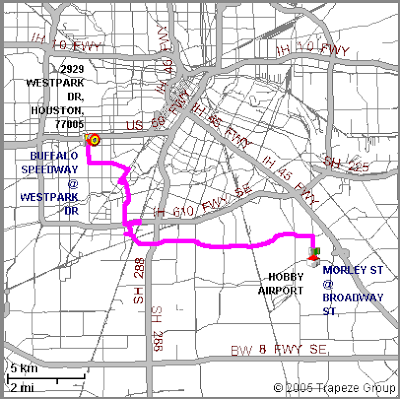
Let's back up a little. At the last minute, I decided to go to the Rice University homecoming to hopefully see some old friends and hang out some with my older daughter Claire, who helps run a bookstore there. I booked a flight, and found my usual close-to-Rice hotel had some good rates, so I got a room. Then I thought, "Hey, I wonder if I can get from the airport to reasonably close to my hotel using mass transit?" Hopping on the Houston Metro website and entering a couple of addresses, I found that I could catch a bus right at the airport that took me to within a quarter-mile of my hotel with no transfers. Wow. Sixteen miles in Houston for a buck and a quarter. Double wow. (The image at right is from the Houston METRO trip planner, very convenient.)

So, that axed the rental car, which saved me about a hundred bucks, probably a hundred thirty with gas. Ka-ching. But it also meant that my in-town trips would be either by bus, by taxi, or by bike. (Now there's an easy decision.) Houston is flat, and the November weather in Houston is really perfect for riding (high 60's to mid 70's, and not terribly humid). And good weather (no rain) in the forecast.

So, to make a long story short, I spent an entire weekend (three days, Friday, Saturday, and Sunday) in Houston, Car City USA, and not once did I even get into an automobile. It didn't seem strange until early Sunday when I realized that I hadn't been in one. Of course all my old classmates thought it weird, but I caught some whiffs of envy among the incredulity, when they asked, "You're kidding! You BIKED to the party?"

Good things: Saving money, great exercise, the flatness of Houston (my little Dahon folder is great for packing, but really not much for hills), Rice University bike parking facilities (basically, good secure bike racks everywhere), not having to worry about parking a car, Daniel Boone's Cycle Shop, and great weather.

Some people complain about Houston drivers. I was told by the bus driver (friendly guy) coming into town that Houston drivers don't respect cyclists, but I had zero bad experiences over about 60 miles in 3 days. Of course I was in a university part of town, where there are quite a few cyclists, but overall, no complaints from me about Houston motorists.

Not so good things: Houston has the world's narrowest bike lanes (where they have them), and the paving in Houston is the pits. Literally. Basically, Houston is built on the flat gulf-coast plains that have a lot of clay in the soil. This "gumbo" as it is called is just hell on pavement. I found myself weaving a lot more than I wanted to be to avoid really nasty potholes and large cracks.

I even had an accident because of the bad roads! It was late at night and I was riding back to the hotel from my daughter's apartment. I hit a bad pothole (hard to see) and went right over the bars (not hard to do on a short-wheelbase, small-wheeled folding bike.) Luckily, no injuries beyond some bruised kneecaps, as I wasn't going all that fast. Not even any torn clothes.

The funny thing is, I picked myself up and dusted myself off, determined the bike was rideable (it needed the derailleur hanger bent back into proper position) and proceeded home. The next morning, I got up early and looked at bike and saw what I missed the night before: my cyclo-computer was missing. Muttering under my breath at my obliviousness the night before, I hopped on the bike and went back to the accident site (I figured if I waited, there was more chance of it getting smashed by a car) and there it was, flung up in a driveway, fully operational. I clipped it back on and went back to the hotel for breakfast.

But it's been almost 30 years since I had an over-the-bars experience! I'll probably be sore for several more days, but the only cure for that is more riding. I really wouldn't mind not ever going over the bars again, ever. Good thing I was wearing gloves. But the accident seemed to underscore the "extreme" quality of the weekend.

I have to say though, I wouldn't hesitate in the least to do a pure "bike holiday" again (except for the accident part). A little planning can yield a lot of riding, and a lot of fun.

Wednesday, November 11, 2009

Weather Wuss

A weather wuss is what I am. When the rain is coming down solidly, I still go for the car. Look at that map. We're socked in from Tropical Storm Ida. I still just can't find the motivation to go out when it's really raining. A light drizzle, sure, no problem. But real rain, man. It's just hard to gear up to go out into a situation where the visibility is poorer, the road surfaces are worse, and the drivers are ultimately more dangerous to me.

I'd really like to hear from commuters out there who manage to go out in inclement weather. I'm really just talking rain (not sleet, snow, or ice) here, and rain that is coming down, not just drizzling (like Seattle rain, which I've also enjoyed riding in.) How do you do it? What has made the difference for you?

Tuesday, November 10, 2009

Blighters Rock

No, it's not really writer's block, I've just been, ah, busy. We're in busy season at Nemetschek, meeting our design deadlines for the next great version of Vectorworks, and I've had my head down.

I've had my head down cycling, also. As I knew would happen, I "made my year" and met my goal of 3300 miles last week. In retrospect, it seems kind of ho-hum. We'll see how many miles I make by the end of the year and I'll try and do some kind of estimation of what percentage of work days I rode to work. I have to say, though, my utilization has got to be really high, if you deduct for business trips. I think I use my car to get to work no more than 2 days per month, at least for the past 3 or 4 months. Good weather (that is to say, reasonably clear weather) helps.

When it comes to understanding urban cycling, there's nothing like statistics. The city of Fort Collins, CO has just released a compilation of statistics about cycle-auto accidents over a 30 month period and I'm working on some analysis of that as well as accident stats from elsewhere. But the news item I've read recently that has I think the most significance is new bicycle usage stats from New York City. Since 2007, the ridership is up 66%. (That is to say, cycling levels in 2009 are 166% of what they were in 2007.) Wow. Check out that chart. (That is a zero-based chart!)

What can account for this? It's pretty simple, really. There's a serious commitment by the NYC DOT to get people bicycling. The city has substantive programs in:
  • Bicycle education and safety;
  • Bicycle parking;
  • Bicycle/Mass Transit interface; and
  • Bike street infrastructure.
The city has created 200 miles of bike lanes in 3 years and is committed to 50 miles of lanes per year until it completes its bike network. Check out the main NYC-DOT page on cycling and drool. For anyone outside of NYC, it is just enviable, to live in a city that has resources and uses them to Make Things Better.

Monday, November 2, 2009

Patch Kit Zen

I've been in some tough deadlines at work, so no posts late October. I've been enjoying riding in the cool autumn weather, enjoying the color, the wet leaf debris on the shoulder not so much, but hey, can't have it all.

Here's a bicycling koan (of uncertain provenance) that has seen a lot of coverage on the Web:

A Zen Teacher saw five of his students return from the market, riding their bicycles. When they had dismounted, the teacher asked the students, "Why are you riding your bicycles?"

The first student replied, "The bicycle is carrying this sack of potatoes. I am glad that I do not have to carry them on my back!" The teacher praised the student, saying, "You are a smart boy. When you grow old, you will not walk hunched over, as I do."

The second student replied, "I love to watch the trees and fields pass by as I roll down the path." The teacher commended the student, "Your eyes are open and you see the world."

The third student replied, "When I ride my bicycle, I am content to chant, 'nam myoho renge kyo.'" The teacher gave praise to the third student, "Your mind will roll with the ease of a newly trued wheel."

The fourth student answered, "Riding my bicycle, I live in harmony with all beings." The teacher was pleased and said, "You are riding on the golden path of non-harming."

The fifth student replied, "I ride my bicycle to ride my bicycle." The teacher went and sat at the feet of the fifth student, and said, "I am your disciple."

Why do I post this? It came to mind late last week. I had done my usual morning preparations, (made breakfast, made coffee, made and packed lunch, packed my change of clothes,) and, as I was just ready to go out the door, loading my backpack/laptop bag into the other pannier, noticed that my rear tire was flat. I cursed under my breath, because I should have seen it the first thing, but wasn't paying attention. I considered changing clothes and driving in to work for no more than 2 seconds, and then got my agitation under control and realized that what I had to do was to do the very best job of fixing that tire that I could.

So I took my time and was careful. No obvious leaks, no hissing. A slow leak. Putting it in the kitchen sink, no leaks the first pass. Added a little more air, passed it slowly through the water, and turned up the very slow leak (about 1 small bubble every three seconds.) Put a peel-n-stick on it, looked for but couldn't find any persistent hazard in the casing, aired it up, got my kit back together, made it to the office only about 20 minutes late.

The payoff? At the end of the day, ready to ride back home, the tire was still rock-hard. I just love beating a leak and (especially) not having to go back and revisit it.

Thursday, October 22, 2009

New Tagline

The new tagline above is from Iris Murdoch. I saw over at Urban Simplicity an article about her that incorporated the quote. I'd been using the H.G. Wells "no longer despair" quote for a while, but things needed a change. Thanks to BuffaloCook over at Urban Simplicity for acquainting me with Iris Murdoch! Here's her Wikipedia page.

Update: I've re-read Iris' quote, and although I don't disagree with its premise, its scope may be too narrow. I have to say, though, that for long distances, high-speed trains are pretty darn civilized, too.

Wednesday, October 21, 2009

Two Interesting Articles in surprising places...

Article 1: Slate, which I haven't read since the end of the election season. (I don't miss my addiction to political online writing much!) Anyway, they published a quite good article by Christopher Beam about vehicularists vs. infrastructurists. Here's a quote:
Vehicularists see the potential transformation of America into a Euro-style bike paradise not just as a far-fetched utopia but as an insult. Dedicated bike paths are an admission that the cyclist deserves pity and should be walled off from the world. Bike paths are separate but unequal—a way for motorists to get bikers out of their way. John Forester, the author and engineer known as the intellectual forebear of vehicular cycling, traces the philosophy back to a set of laws introduced in 1944 that relegated bikes to the far right of the road, prohibited cycling outside of bike lanes, and banned them from the street if bike paths were available. (These laws were part of the Uniform Vehicle Code, a national model on which states base their own traffic laws.) Since the rise of the automobile, vehicularists have seen any attempt to treat bikes differently as a civil rights violation.
Go check it out.

On a related (sort of) topic, I've been thinking about the typical legalese in the Uniform Vehicle Code adopted by most states that talks about "[bicyclists] may ride two abreast if not impeding traffic." Certainly our intuition tells us that bicycles "impede" auto traffic, but I think the truth is a little less obvious. If we think about "impeding" traffic as being the same as "congestion" (reasonable enough, I submit), then at least in theory, widespread bicycle use should produce less congestion (by using up less roadway) and therefore bicycles, while microcosmically acting as an impediment, macrocosmically reduce congestion!

Which is a sort of round-about lead-in to article 2, in the Wall Street Journal, which makes the dubious claim that traffic jams, by providing disincentives for driving, are "good" for the environment. (It's of course a rather transparent plea to avoid congestion taxes, but hey..)

Monday, October 19, 2009

Impeach Rick Perry

Rick Perry, the governor of the State of Texas, is a lying tyrant and should be impeached.

There might be people who think that statement is just a wee bit strong. But you know, I just don't know how to put it more plainly and simply than that. I'm sure that most readers of this blog know the basics of the story by now, but just in case, let's review them:

The Legislature of the State of Texas soundly passed a bill, SB 488, "Relating to the operation of a motor vehicle in the vicinity of a vulnerable road user; providing penalties," intending to protect (among others) bicyclists in the state of Texas. It was passed out of committee by a vote of 7-2. The bill was passed by a vote of 142-0 (with 2 abstentions) in the Texas House of Representatives last June 2, and on June 3 by 26-5 in the Texas Senate (so I trust there will be no challenge to the word "soundly".) The bill was certified by the conference committee to have no negative fiscal impact on either the State of Texas nor the communities of Texas.

A web page for the bill, from which the text can be downloaded, is here.

The bill would have required motorists to give cyclists and others categorized as "vulnerable road users" at least 3 feet of clearance when passing on most highways. The "vulnerable road users" category would have included pedestrians, highway construction and maintenance workers, tow truck operators, stranded motorists or passengers, people on horseback, bicyclists, motorcyclists, moped riders, and other similar road users.

Texas Governor Rick Perry, in an action surprising to some observers, vetoed the bill last June 19th. (The Texas state Constitution gives the Governor ten days after receiving a bill to either sign it or veto it, I don't understand why this bill could have been vetoed after 16 days. But that's for more expert Texas legal minds to ponder.)

Perry, a mountain-biker who recently broke his collarbone in an accident, said that many road users in this category already have operation regulations and restrictions in state law. He stated,

“While I am in favor of measures that make our roads safer for everyone, this bill contradicts much of the current statute and places the liability and responsibility on the operator of a motor vehicle when encountering one of these vulnerable road users.”

Perry is plainly lying when he says that he is "in favor of measures that make [Texas'] roads safer for everyone." This statement can be explained no other way. (It's not merely a lie, it's a bald-faced lie, one that is so obvious and blatant that it dares to you call it such, and I choose to do so.) So now let's address the "Tyrant" part of my earlier epithet.

Perry as governor of Texas doesn't have a lot of power, really. The real power is in the Legislature (the "Lege" as it was referred to by the late great muckraker and humorist Molly Ivins.) The only real power the Governor has is the veto. Perry has misused this power: In the four legislative sessions completed while he was governor, Perry has vetoed 203 bills – more than any other governor of Texas. He is also the longest-serving governor in Texas history. (What are you Texans out there thinking, anyway? If you elected a fire-hydrant to the office of Governor, at least it would do less harm than Perry!) This petulant and corrupt over-use of the veto authority is taking power out of the hands of the legislature and the people they represent, hence my use of the "Tyrant" epithet.

The state of Texas has a provision for the legislature overriding governor vetoes, but according to this article, there are procedural issues that make overrides difficult. So the Texas Legislature has written a bill providing for a Constitutional amendment to allow the Legislature to call a special session to deal specifically with veto overrides. However, according to Texas Senator Jeff Wentworth (R), Perry and Lieutenant Governor David Dewhurst are conspiring to prevent the constitutional amendment from making the floor of the Senate.

All of this would be moot if the state of Texas enforced the laws on its books (you know, those laws that Perry says suffice.) But they don't. If you're a cyclist in Texas, you have very little protection. Consider the tragic case of Gregory and Alexandra Bruehler. The San Antonio couple were riding a tandem on the shoulder of Highway 16 north of Helotes, TX when a truck struck them from behind. They were both killed and leave behind a 7-year-old daughter. (Heart-rending images of the daughter abound in the blogosphere, and I won't reproduce them here.) Local news reports that “investigators say there are no charges on the driver. They believe this was an 'accident' and that somehow the driver lost control of his truck.” Even though the driver was reportedly exceeding the speed limit. That, dear friends, is the state of law enforcement in Texas (and, to be fair, in other states.)

You might think that, given this (admitted) diatribe, I don't care for Texas. But that's not true. I lived for almost 30 years in Texas, and I love that state, and I love Austin, where I married and had kids. I love Texas, but I've had enough of lame-brained Texas politics. Just like another stupid mountain-biking governor of Texas, this one should be impeached.

Memo to Texas Legislature: Grow a pair.

Memo to State's Attorneys across the State of Texas: start doing the job you were elected to and enforce the laws that are on the books.

Friday, October 16, 2009

Bike fitting

Bike fitting, buying and finding and adjusting a bike to work well with your body, your flexibility, your strength, and your needs, is an important topic. Today I've put together a post that covers some of the online resources for bike fitting, and also briefly discusses fitting services and systems.

On-line Guides: First I'll give a brief survey of some of the online fitting guides. At top right is a chart detailing the topics covered by these sites:

Rivendell Bikes has a nice online guide for choosing a bike. This is predominantly a guide for choosing a frame size, based predominantly on pubic bone height (AKA "inseam"). It has an interesting rule for how to determine the leaning angle of the torso. This is oriented towards comfort and not racing sizing (which really is not addressed by any of these sites.)

Bikerowave (love the name) has a pretty plainly presented (looks like a forum entry) discussion, but the information there is good.

Jim Langley's excellent site has made the posts of this blog before. He presents fitting as a troubleshooting guide. Good if the bike you already own falls within the range of what you need, not so useful as a buyer's guide. (Langley quotes from Ivan Illich -- hm, good topic in itself for some future post.)

Kirby Palm's long discourse on bike fitting is encyclopedic. Anyone who can write this much on a topic probably knows something about his subject. If not, let's hope he gets lucky. Seriously, this is arranged in a somewhat wordy narrative, but is quite comprehensive and useful.

Peter White Cycles has a page on the topic. It provides some general advice on frame fitting as well as advice on selecting the kinds of merchandise Peter sells. (I really like Peter's site and sincerely appreciate the information he provides. I would buy from him a lot more if he made it easier to do so.)

The Colorado Cyclist site has a thorough (if not particularly broad) guide. It uses a step-by-step approach that I like in this kind of guide.

Wabicycles has a frame-spec focused site that is oriented toward fixies. It information is compactly organized and not unsophisticated. Definitely the place to go if you're thinking about converting that old Raleigh from the '70s into a fixie.

Fitting Systems: Let's suppose, however, that you don't feel confident about measuring a bike (or yourself) and just want to have it done for you. There are a couple of bike-fitting hardware systems sold to bike shops whose personnel are usually certified to use them. Perhaps a shop in your area has one of these systems:

Bike Fit Kit: The "Fit Kit" sold to cycle shops to determine bicycle fit. Since they sell the kits, they don't "give away" their methods online, but visiting their site is interesting in what it says about their approach.

The Fitmaster is the all-in-one fitting machine seen in many bike shops. Shops in at least 25 states in the US have these. A nice, integrated system combined with training on how to use it. This is a good investment for any bike shop, it would seem.

Some randomly-chosen services using (probably) one of the above systems are listed below:

Ride Boutique is certified on several different fitting systems. If you live near Ann Arbor and have a couple of Benjamins to spare, this might be time (oh, yes, and money) well spent.

Papa Wheelie's bicycle shops (again, I love that name) in Boston and Portsmouth, NH also has advanced fitting services. They mention the magic word, "chondromalacia," which I suffer from.

Bicycle fitting services in Tampa, FL. Seem reasonably priced.

eBooks: Lastly, you may simply be a book person, and the comfort of the printed page (that is, if you're willing to print it yourself, as these are ebooks) is the way to go for you. (I can certainly understand this.) There are a couple of titles that come to hand, based on my Internet search:

Arnie Baker's "Bike Fit" ebook. If you're a learning-oriented, self-reliant kind of person, this may be for you. A whole lot less expensive than a fitting session, too.

Andy Pruitt's Medical Guide for Cyclists. Ebook. Combines a section on bicycle fitting with a section on injuries / prevention / care.

Friday, October 9, 2009

Across the chasm

The renowned cult author, Robert Pirsig, wrote an article for Esquire magazine in 1977 about cruise sailing wherein he observed that people who had spent years and lots of money preparing for once-in-a-lifetime cruise sailing voyages often cut them short, disappointed and disillusioned, eager to get "back to reality" from their dream cruises that had turned into nightmares.

Here are a couple of excerpts that apply, directly or indirectly, to bicycle commuting, I think:

The house-car-job complex with its nine-to-five office routine is common only to a very small percentage of the earth's population and has only been common to this percentage for the last hundred years or so. If this is reality, have the millions of years that preceded our current century all been unreal?

An alternative - and better - definition of reality can be found by naming some of its components ...air...sunlight...wind...water...the motion of waves...the patterns of clouds before a coming storm. These elements, unlike twentieth-century office routines, have been here since before life appeared on this planet and they will continue long after office routines are gone. They are understood by everyone, not just a small segment of a highly advanced society. When considered on purely logical grounds, they are more real than the extremely transitory life-styles of the modern civilization the depressed ones want to return to.
...
Now, however, with a boat of my own and some time at sea, I begin to see the learning of virtue another way. It has something to do with the way the sea and sun and wind and sky go on and on day after day, week after week, and the boat and you have to go on with it. You must take the helm and change the sails and take sights of the stars and work out their reductions and sleep and cook and eat and repair things as they break and do most of these things in stormy weather as well as fair, depressed as well as elated, because there's no choice. You get used to it; it becomes habit-forming and produces a certain change in values.
Taking responsiblity for my own transportation is such a liberating thing, and I think it's exactly what Pirsig is talking about. What the weather's going to do, how I have to dress for that, how long it's going to take to get to the office, how my legs feel and how steep the rises are, all these things are part of my "daily chores". Every hill is an opportunity to find the perfect gear to carry me. Headwinds are an opportunity to orient my direction to the cardinal points and get a better sense of my space on the map as I go home. That squeak in the chain means that I'm going to have drop it and lube it soon. My right knee is twinging a bit, better gear down. The way those clouds are moving means that the rain will be over in no more than 5 minutes.

Those cars going by me are big and hot. And heavy, really massive. They are big metal-and-glass parlors on wheels carrying large amounts of flammable liquid. Sometimes the drivers are aware of me, sometimes not. Most of the drivers don't seem too happy; a lot of them are distracted, talking on their cellphones.

As I sit here typing this post, two (count 'em) car ads have come on late night TV touting new cars with "driver-assist" technology. You know, computer-aided steering that moves you back into the land if you wanter, or senses when you're nodding off and alerts you. All this stuff is going to put just more stuff between the drivers who buy these (very expensive) cars and reality.

Pirsig is right. Dealing with reality, if made into a habit (and taken in manageable doses) is value-forming and -enhancing. Motorists have their "reality". In their world, what I do is crazy, dangerous, and even childish. (They wonder when I'll "grow up and get a car"!) In my world, what I do is entirely safe, fun, life-enhancing and (especially) real.

I do drive sometimes, when the situation demands it. (I will have to tomorrow.) So it's easier for me to understand the perspective of a motorist. But 99% of all motorists will not have my cycling experience. It's like we are on the opposite rims of a canyon.

Tuesday, October 6, 2009

Juking the Cars

I was going to call this post "Vehicular Jiu-Jitsu", but technically Jiu-Jitsu implies using the weight (and momentum) of your opponent against him, and in terms of weight and momentum, the cars have all the advantage. So I realized I was really thinking about another "J" word, from American sports (it's used both in American football and basketball): Juking.

The online slang dictionary defines the word thus:

juke |joĹŤk| informal

verb [ intrans. ]
1 to cheat.
2 to not meet someone as planned; to "stand up."
3 to fake out or to feign [sports].
4 to dance provocatively.

The applicable definition here is #3. In basketball, to "juke the defender" means to fake a shot (to get the defender to leave his feet) and, while the defender is in the air, drive by him. In football, the "juke" is a weaving or swerving pattern used by receivers to lose their defenders. In both cases, the offensive person make a move to get the defender to hesitate, and then takes advantage.

It happened in traffic the other evening, coming home. I was trying to move into the left lane in traffic to get into a left-turn-only lane. I had my arm out, and two cars had passed me by (the second one made me a little angry -- he had plenty of time to see me and give me room.) The guy in the third car was going to try and sneak by (I was "just a cyclist", after all) but I crowded him, swerved ever so slightly into his lane and he backed off. He didn't want to -- he gave me quite the dirty look as he passed me by on the right. When I saw what he was driving, (a Mercedes S-class) I gave myself a couple of bonus points, as I suspect he wasn't used to getting backed down by drivers in lesser cars, much less a cyclist.

Welcome to the juke, fella. Don't be angry with me just because I maneuvered you into doing the right thing.

This ability to make a split-second judgement about what a driver is doing (or likely to do) is one of, if not the most challenging aspect of vehicular cycling.

Particularly in this situation -- drivers wouldn't dream of overtaking a car slowing down with its left turn-signal on, but many, many drivers think they can sneak by a cyclist doing exactly the same thing. Although it helps to be taking the lane pretty aggressively, I've still had drivers zoom by me when I'm full in the lane with my arm out. I can't explain this level of motorist negligence.

I don't know how this is taught in the LAB classes (as I've not been able to attend one yet, but that's another story). I think it is one of the most "athletic" aspects of VC, so the athletic analogy is well-suited here.

NB: The image above is from a very cool web page illustrating "Self-Defence with a Walking-Stick," originally from a 1901 edition of Pearson's magazine.

Sunday, October 4, 2009

Fashionista

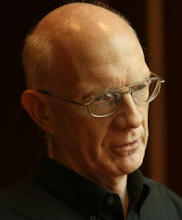
Mikael Colville-Andersen (that's him at right) is a film-maker and the blog author over at Copenhagenize and Copenhagen Cycle Chic. I heard him speak at the Washington DC Planning Commission last Wednesday night. Mikael is a good public speaker and a charming and funny guy, and he is promoting a provocative idea about urban cycling and cycling policy:

We could have all the benefits of Copenhagen cycling if we just, you know, dressed a little nicer on our bikes, if we just marketed bicycling as an activity by, um, looking more like a fashion plate.

Mikael cites a lot of statistics (if, for example, you go over to Copenhagenize, you can see a running total of bicycle miles ridden in Copenhagen up to the moment) and makes a number of frankly good points about the Copenhagen environment. He talks about all the bike infrastructure that's being implemented in Denmark, and he spends no small amount of time addressing the fact that cycling is so much a part of the Danish lifestyle that people who do urban cycling in Copenhagen don't think of themselves as "cyclists". To what does Mikael attribute this great example for the rest of the world? To the fact that the Danish cyclists dress well, with a sense of style, (and that the men wear suits). Mikael asserts that bicycling's lack of status (outside of Copenhagen and -maybe- Amsterdam) is due to the fact that we just don't dress well enough.

Mikael, excuse me for saying so, but I think you have your cause and effect either reversed or at best very muddled. Your fashion premise is a fiction. An amusing fiction, and one that we might all like to imagine ourselves in the midst of, but a fiction nonetheless.

I've been pretty tough on Mikael so far this post, (and I beat up on him a little in a previous post) but I will certainly concede that in his talk he does make some interesting and (mostly) valid points about the "values inversion" of the way that cars and automobiles are marketed:
  • Which is truly more "liberating", an auto or a bicycle?
  • Which is truly more dangerous, an auto or a bicycle?
  • Which is truly sexier, driving a car or riding a bike?
  • Should automobiles have warning labels like cigarettes?
and he does a nice historical exposition of bicycle posters, to show how bicycles and bicycling (as a tourist activity) have been marketed over the 20th century. These are valid, and I appreciate all this. And Mikael's "cycle chic" (thinly disguised girl-watching, but hey, I like this as much as the next guy) is supported in this article in Sci-Am about the incidence of female cyclists.

But the promulgation of "cycle chic" is just wrong as primary policy. Why do I say this? Two reasons. One, it's an effect, not a cause. And Two, because there are bicycling advocacy groups who will buy into it because it's easy. "All we have to do is increase our marketing budget and find some good-looking models, and our urban cycling problems will diminish!" Excuse me, but this is reductionist malarkey.

Over the past couple of years, I've spent enough time in Europe, in Belgium, France, Germany, Switzerland, and Sweden, to see the truth about why urban cycling in these places is different from the US. The truth of it is, what make cycling work in Copenhagen (and Amsterdam, Basel, Berlin, Brussels, Stockholm and elsewhere) is the combination of two components:
  1. Motorists' near-universal respect for bicyclists*; and
  2. Bicyclists' near-universal respect for traffic laws.
These two complementary components, while not impossible to enable in the US, are, nonetheless, longer-term and messier than a simple marketing campaign. Making these two things happen in the US will involve "the three E's":
  • bicycle safety education (best if done in public schools from an early age);
  • enactment of laws that protect bicyclists in a reasonable way; and
  • consistent and fair enforcement of those laws.
Denmark has all these things, and that is why Copenhagen residents use bikes casually and don't need to think of themselves as cyclists. (Some of the readers of this blog have already commented on the Danes' observance of traffic laws.) And this has created the secure environment that allows them to 'dress up' when it suits them. Not the other way around.

Postscript: Am I guilty of taking Mikael too seriously when he is intending to be 100% ironic? Hm. It is a possibility. But if Mikael really wants to get the substantive good news out about Danish cycling, there is certainly a lot of it that he's bypassing. Consider this excellent report (PDF) from the English reports pages of the Danish Road Directorate. (It's from the year 2000, but is the most recent paper on this topic.) In a (partial) defense of Mikael's "marketing" position, there is this quote:
It is important to link soft policies (campaigns, instruction etc) with hard policies (infrastructure, taxation etc). The combination of hard and soft policies is necessary in order to achieve a big change in travel behaviour, both regarding transport mode choice and road safety.
Notice that the quote does mention "campaigns" but in the same breath talks about education as well as "hard policies". In fact, the report is such a good report and so well researched and balanced, and give such a good picture of the real policies that need implementing that it somewhat reinforces my picture of Mikael as being reductionist. And mind you, the source of this document is the Danish highway department. Consider how different the US would be if we had our highway departments actively researching and promoting cycling! As just one example, consider the chart below and the story it tells:
But hey, all of this doesn't mean I'm not a curmudgeon :)

*There are exceptions to this, especially in the UK which for some reason tracks the US more closely.